(单词翻译:单击)
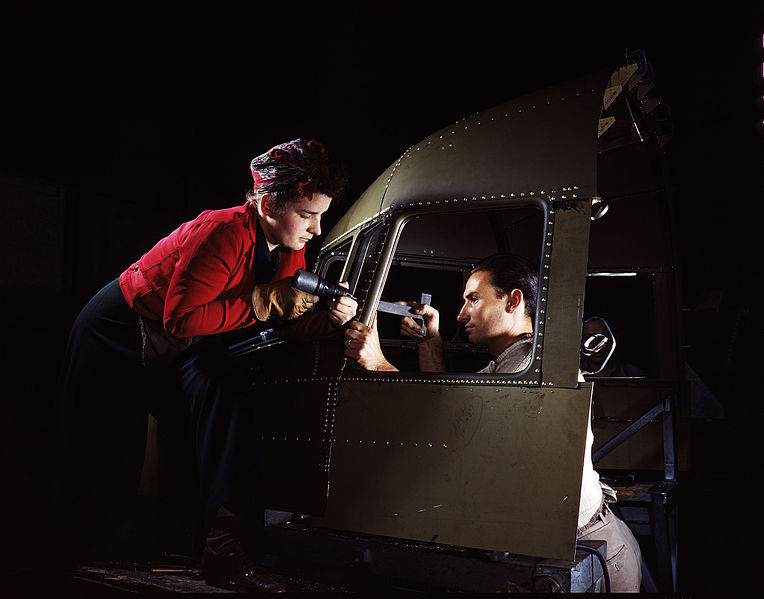
To train an onslaught of inexperienced labor, employers developed techniques.
为了培训大批没有经验的劳工,用人单位想了各种各样的办法。
Some of them were likely sexist:
部分单位几乎走上了男性至上主义的道路:
"They were as fast as men if not faster,
“她们的速度即便没有超过,也不低于男人们的速度,
for rivets are the buttons of a bomber to hold it together against a speed of nearly 350 miles an hour."
因为铆钉就是轰炸机的纽扣,要将各个零部件牢牢地扣在一起,不影响轰炸机以近350英里/小时的速度飞行。”
Others sped up training for employees who had to learn an entirely new job really quickly.
其他单位则加快了员工培训的节奏,因为她们都要迅速了解一份全新的工作。
"Women workers can be surprisingly good producers.
“女工是能成为极其优秀的生产者的。
You've got to study every job and subdivide it into simple operating steps.
你得仔细研究每一份工作,然后把它们细分成简单的操作步骤。
'Mary Anderson of the Women's Bureau recommended riveting,
“女性事务局的玛丽·安德森建议让女工们进入铆工行业,
"which is the most common job throughout assembly."
“因为铆工是整个组装过程中最常见的工作。”
The Women's Bureau recruited for these jobs in ways that appealed to contemporary notions of women's traits:
招聘这些职位时,女性事务局迎合了那个时代对女性特质的普遍看法:
riveting used "a delicate touch, manipulative dexterity of a high degree, as well as extreme accuracy in measurement."
铆工要求(求职者)具备“细腻的触感,高度的操作灵巧性,以及测量的极高精确度。”
Teamwork could help with training.
团队合作对培训也有一定帮助。
Rosalind Palmer, who inspired the name Rosie the Riveter,
“铆工罗茜”这一名号的灵感来源罗莎琳德·帕尔默
started out as a riveter but became a welder after she was paired with a "crackerjack welder" who "taught me all he knew."
一开始就是一名铆工,后来,和一名“将所学悉数传授给了我”的“精力充沛的焊工”组队后,她就做了焊工。
The training showed results.
培训起作用了。
Boeing Seattle quadrupled monthly output from 1942-1944.
1942年到1944年间,波音西雅图工厂的月产量直接翻了两番。
In Detroit, worker hours per bomber dropped at the Ford Willow Run Bomber Plant.
底特律,福特公司柳树轰炸机厂制造轰炸机的工时也缩短了。
They went from 200,000 to less than 18,000 hours,
从20万小时缩短到了不到1.8万小时,
thanks in part to increased efficiency from subdividing jobs.
一定程度来说,这一成绩与细分工作带来的效率的提高是分不开的。
These riveters succeeded in transforming the war effort—and the labor market.
这些铆工成功地扭转了战局——也改变了劳动力市场的格局。
Rosie the Riveter is truth and myth.
铆工罗茜有它真实的一面,也有它虚构的一面。
Look at this pin.
看看这个徽章。
"We Can Do It" was a poster the Westinghouse Electric company made to briefly show at its factories.
“我们能行”原本是西屋电气公司制作的一期海报,当时只在其工厂里短暂展示过。
The real-life woman who inspired her likeness was an Alameda Naval Air station employee named Naomi Parker.
真正激发这一肖像灵感的女人其实是阿拉米达海军航空站一位名叫内奥米·帕克的员工。
Rosie became mythologized in a Norman Rockwell painting, a song — "Rosie, the Riveter" — and even a movie shortly thereafter.
后来,罗茜就变成神话出现在了诺曼·罗克韦尔的油画里,出现在了歌里——《铆工罗茜》——甚至还出现在了不久之后拍摄的一部电影里。
And the Westinghouse poster became all-but-ubiquitous when a copy was unearthed in the 1980s.
西屋电气的这张海报变得随处可见也是80年代后发生的事情,还是因为一份复印被发掘了出来才发生的。
But the truth about real riveters was more complicated, and it didn't make the poster.
不过,真实的铆工们真实的故事并没有这么简单,她们的故事也没有登上海报。
In 1942, Thelma McKelvey of the War Production Board testified that
1942年,战时生产委员会的Thelma McKelvey作证说,
women were paid 10 to 15 cents an hour lower, despite equal pay regulations.
尽管有同工同酬的规定,女性的时薪还是比男性低了10~15美分。
Results varied wildly by company and region,
尽管公司和公司之间,地区和地区之间存在明显的差异,
but during the war, some unions used claims of seniority and job differentiation to keep women's pay down.
但战争期间确实有部分工会以资历和工作差别为由压低女性的工资。
They also pushed for women to give back "men's jobs" when the war was over.
他们还大力要求战争结束后女性将“男性们的工作”物归原主。
"How you like your job Mrs. Stoner?"
“你喜欢你的工作吗,斯通纳太太?”
"I love'em."
“我爱我的工作。”
"How about after the war? Are you going to keep on working?"
“战争要结束了呢?你还会继续工作吗?”
"I should say not, when my husband comes back, I'm going to be busy at home."
“应该不会,我丈夫要回来了,家里就够我忙的了。”
"Good for you."
“那挺好的。”
"What about after this war, Lee?"
“仗要打完了呢,李?”
"Well, this job belongs to some soldier, and when he comes back, he can have it."
“这个嘛,这本来就是某个士兵的工作,等他回来了,还给他就是了。”
"Ah that's swell."
“啊,那可太棒了。”
Women of color were also discriminated against in some places.
有色人种女性在某些地方也会受到歧视。
Black women in industry went from 6.5% to 18% during the war.
战争期间,进入老工行业的黑人女性的比例从6.5%上升到了18%。
But employers were spotty.
用人单位的水平却是参差不齐。
At Wagner Electric in St. Louis, 64% of employees were white women, 24% black males, and 12% white males.
圣路易斯的瓦格纳电气雇佣的工人中,有64%的白人女性,24%的黑人男性,还有12%的白人男性。
They simply did not hire black women.
他们直接就不雇佣黑人女性。
Most women who did work were already in the workforce, single, and without children,
当时有工作的女性大多都是之前就已经在工作的,没有孩子的单身女性,
so it's easy to overestimate how much the war changed things.
所以,我们很容易就高估了这场战争带来的改变。
Total working women also declined when the war ended.
战争结束后,劳动女性的总数也减少了。
But World War II did transform public and private sector labor.
不过,二战确实改变了公共部门和私营部门的劳工构成。
About half the already-employed women switched employment from clerical work to higher paying manufacturing work.
有将近一半站前已经就业的女性从文书岗位转到了报酬更高的制造业岗位。
And the number of employed married women increased during and after the war.
而且,无论是战争期间还是战争结束后,已婚女性的就业人数都出现了增长。
The real story of women riveters is more complicated than a poster or a slogan.
女铆工的真实故事并没有海报或标语里那么简单。
But together, private industry, women leaders, and all those working women changed work in America — one rivet at a time.
不过,总体而言,私营行业,女性领袖以及所有这些职业女性确实一个铆钉一个铆钉地,一步一个脚印地改变了美国劳工市场的面貌。


