(单词翻译:单击)
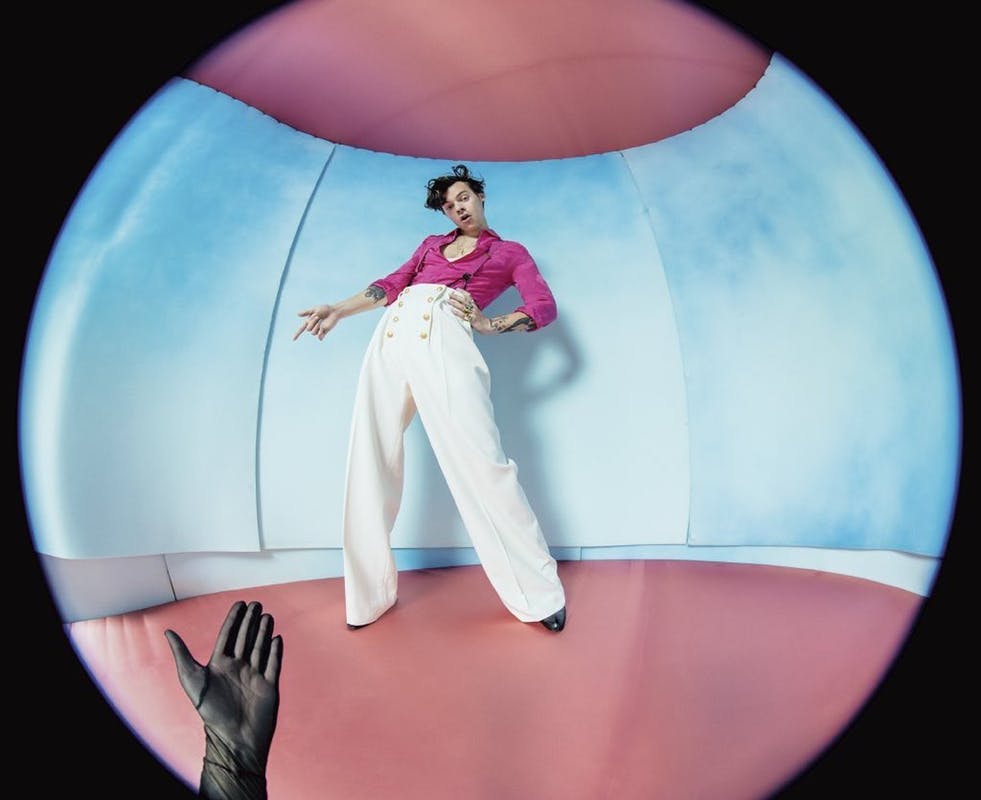
On Nov 4th 2019, former boy band member and current fashion icon, Harry Styles, posted an image to twitter.
2019年11月4日,前男团成员、现时尚教主“哈卷”哈里·斯泰尔斯在推特上发布了一张照片。
Within 24 hours it racked up over half a million likes.
不到24小时,这条推文就获得了超过50万个赞。
It was the cover to his long awaited sophomore album, and fans dissected every last detail.
这张照片也是大家期待已久的,他的第二张专辑的封面,所以,照片的每个细节粉丝们都没有放过。
From the pink and blue color palette, which was used for the studio backdrop, his custom Gucci outfit, and was even painted on his fingernails.
无论是照片所用的粉、蓝两种颜色——不仅工作室的背景用到了这两种颜色,他Gucci定制套装,甚至他的美甲都用到了这两种颜色。
To this disembodied hand in the corner, which belongs to Tim Walker, the photographer.
还是照片下方伸出的那半截手臂——那其实是摄影师蒂姆·沃克的手。
And finally, the scandalous release date - Friday December 13th.
最后还有令人震惊的发布日期——12月13日,星期五。
His ex-girlfriend, Taylor Swift’s, birthday.
那天刚好是他前女友,泰勒·斯威夫特的生日。
But zoom out to the whole image, and you’ll see something that extends far beyond the world of Harry Styles fandom.
然而,把镜头拉远框进整个画面,你会看到一些远超出哈利·斯泰尔斯影迷所看到的那个世界的东西。
This circular photograph is the latest in a long line of album covers that have that same warped composition.
这张圆形照片其实是一长串采用这种变形构图的专辑封面中的最新成员。
This is the story of music’s obsession with the fisheye lens.
欢迎收看本期关于音乐圈痴迷鱼眼镜头的故事。
In 1906 renowned physicist Robert W. Wood was in his lab at Johns Hopkins University
1906年,著名物理学家罗伯特·W·伍德正在约翰·霍普金斯大学的实验室里,
with a bucket full of water, a pinhole camera, mirrored glass, and a lot of light.
他准备了一桶水、一个针孔照相机、还有镜面玻璃和大量的光线。
He wanted to see if he could create an image of the world from the perspective of a fish.
他想看看他是否能创造一个鱼眼中的世界。
Whose view from underwater compresses the entire horizon.
也就是从水下观看,整个地平线都被压缩的世界。
This experiment might seem unusual,
这个实验可能看着有些不太寻常,
but Woods was a professor of optical physics and he dedicated his career to inventing unconventional tools to study light.
但伍兹是光学物理学教授,他把自己的整个职业生涯都奉献到了研究非常规的,研究光的工具上了。
From developing this disk whose microscopic components helped determine the age of stars,
比如他研究出了这个微观组成能够确定恒星年龄的圆盘,
to inventing this toy which, according to the patent," created grotesque images of people’s faces" through a series of perfectly placed mirrors.
他还发明了这个玩具,专利证书上写着,这个玩具用一系列放置得恰到好处的镜子“能创造出非常怪诞的人脸形象”。
"I first heard of him as being sort of an offbeat kind of guy
“我第一次听说他的时候,只知道他是那种比较另类的人。
that often had a deep insight into things in kind of a quirky way."
他总有深刻的洞察力,而且看待事情的角度也比较离奇。”
That’s John Beaver, a photographer who is also a Professor of Physics and Astronomy.
这位是约翰·比弗,他是一名摄影师,同时也是一名物理学和天文学教授。
"That basic diagram of the rays coming at different angles, I mean, I teach that all the time, it’s in every beginning physics book.
“那张光线从不同角度射入水面的原理图,我一直都在讲,每一本物理入门书里也都有。
But the idea of making a camera out of that, I had never heard that Robert Wood had done that."
但要用这一原理造一种相机,我从来没听说过罗伯特·伍德已经用它发明了一种相机。”
In this paper, Wood detailed what he wanted to see:
在这篇论文中,伍德详细阐述了他想要看到的东西:
He said, "the circular picture would contain everything embraced within an angle of 180 degress in every direction, i.e. a complete hemisphere."
他说,“圆形的图像会包含180°以内,而且是每个方向的180°以内的所有东西,换句话说就是能看到一个完整的半球。”
And luckily, he left us with a set of instructions.
幸运的是,他给我们留下了一套操作指示。
Diameter of the paper, what’s that?
“纸的直径,这是什么意思?”
"Open only in photography darkroom. I feel like I’m about to murder somebody."
只能在摄影暗房里打开。我感觉我在准备杀人啊。”
"Let’s go get some water."
“我们去取点水吧。”
"Anchors away."
“起锚出发”。
"Let’s get another one of those clamps."
“我们再拿个夹子试试吧。”
"In case of contact flash skin or eyes with water for at least 15 minutes."
“如果皮肤或眼睛接触水15分钟以上……”
"That’s fine."
“可以的。”
"Oh, no, it’s not because it has to be under the pinhole."
“完了,是要从这个小孔下面观察的。”
I honestly have no idea how the hell he did this.
我真不知道他是怎么做到的。
"I think there's an easy way for you to do it now that he couldn't have done.
“我觉得,现在肯定有更简单的办法而且是他那时候做不到的办法来做这个实验。
You can just put a waterproof GoPro in the bottom of the bucket."
放一个防水的GoPro到水桶底部就行了。”
God dammit. Can we just cut to the pictures?
擦嘞!我们直接看照片好吗?
This is a picture he took from under a bridge.
这是他从桥下拍的一张鱼眼视角的照片。
This is a lineup of men.
这是一排人站队的照片。
And this is what a fish might see if all those men were looking down at it from above the surface of a pond.
这张则是一条鱼可能看到的,一群人从一个水塘上往下看它时的情形。
Soon, researchers and scientists built on Wood’s idea.
很快,研究人员和科学家们就对伍德的构思做了进一步的发挥。
From 1915 through the 1930s, it was the fields of meteorology and astronomy
从1915年到1930年代,气象学和天文学
that drove the development of a camera lens that could capture that coveted fisheye perspective.
成了推动这种可以捕捉到令人羡慕的鱼眼视角的照相机镜头的开发的新动力。
And on the eve of World War II, German inventors filed a patent for a lens which they then shared with the Japanese company Nikon.
二战前夕,德国发明家为一款镜头申请了专利,后来又用这款镜头同日本的尼康公司达成了合作。
The lens used the same principles as Woods’ water experiment.
这款镜头用的和伍兹的水实验用的其实是同一个原理。
"You can see it right in his diagram with the bucket.
“从他那张带桶的原理图就能看出这点。
As the light rays come in at a steep angle, they come out at a less steep angle.
光线以较大的角度射入水面时,就会以较小的角度成像。
And so light rays that are coming from huge angles are compressed onto the picture."
所以,大角度射入的光线也会被压缩到图像上。”


