(单词翻译:单击)
第一节(共5小题;每小题1.5分,共7.5分)
听下面5段对话。每段对话后有一道小题,从每题所给的A、B、C三个选项中选出最佳选项。听完每段对话后,你将有10秒钟的时间来回答有关小题和阅读下一小题。每段对话你将听一遍。
1.What will the woman probably do now?
A. Go for a trip. B. Board the plane. C. Take a rest.
2.What is the man doing?
A. Offering help. B. Asking for advice. C. Making an appointment.
3.What would the woman like to have now?
A. A. glass of wine. B. Some more chicken. C. Nothing else.
4.Where are the two speakers talking?
A. At home. B. On the phone. C. At the restaurant.
5.What is the probable relationship between the two speakers?
A. Waiter and customer. B. Teacher and student C. Boy and girl friends.
第二节(共10小题;每小题1.5分,共15分)
听下面4段对话或独白。每段对话或独白后有几道小题,从每题所给的A、B、C三个选项中选出最佳选项。听每段对话或独白前,你将有5秒钟的时间阅读每小题。听完后,每小题将给出5秒钟的作答时间。每段对话你将听两遍。听第6段材料,回答第6至7题。
6. Why does the woman think New York is a nice place to live in?
A. It has a large population. B. It offers an exciting life. C. It’s interesting and quiet.
7. Where does the conversation take place?
A. In New Zealand. B. In the US. C. In Canada.
听第7段材料,回答第8至9题。
8. What does the man usually do at home?A. Do the washing-up. B. Wash clothes. C. Clean the car.
9. What does the man promise to do at last?
A. Do all the housework from next weekend.
B. Clean the kitchen after cooking.
C. Prepare meals every day.
听第8段材料,回答第10至12题。
10. Why is the woman a bit nervous?A. She is afraid of getting up late.
B. She is a newcomer to the school.
C. She isn’t ready for the coming exam.
11. What must the students do before morning reading?
A. Hand in homework.
B. Do morning exercises.
C. Go to the teacher’s office.
12. What can the students do if they feel hungry?
A. Ask the teacher for some food.
B. Have something to eat in class.
C. Eat something during the break.
听第9段材料,回答第13至15题。
13. How did the speaker go to Manhattan from Long Island?A. By bus. B. By ship. C. By subway.
14. What was the weather like during the speaker’s visit to New York City?
A. Warm. B. Cold. C. Sunny.
15. What do we know about the speaker?
A. The speaker visited Manhattan alone.
B. The speaker didn’t know how to ice-skate.
C. The speaker went to the top of the Statue of Liberty.
第三节(共5小题;每小题1.5分,共7.5分)
听下面一段对话,完成第16题至20题,每小题仅填写一个词。听对话前,你将有20秒钟的时间阅读试题,听完后你将有60秒钟的作答时间。这段对话你将听两遍。请将答案写在答题纸上。Sunnyside Inn Reservation Information
Name of the guest Bob 16
Available rooms a smoking room
a non-smoking room
a room of 200 dollars per 17 , plus a 10% room tax
Reservation a non-smoking room for 18
on 19 20th
Total fee _20 _ dollars, plus a 10% room tax
第二部分:知识运用(共两节,45分)
第一节 单项填空(共15小题;每小题1分,共15分)
从每题所给的A、B、C、D四个选项中,选出可以填入空白处的最佳选项,并在答题卡上将该项涂黑。
21. — You look great!
— I ______ out. Check out my muscles!
A. will work B. was working
C. have been working D. had been working
22. ______ Stephon Marbury is an American, he has become a role model among Beijing
basketball fans.
A. As B. Although C. When D. Since
23. It’s been discovered in the study ______ people are more relieved after forgiving others.
A. that B. what C. which D. whose
24. Grandpa was shocked by the news. Rarely ______ him so quiet.
A. do I see B. had I seen C. I had seen D. I saw
25. The report aims to explain how these conclusions ______.
A. were reached B. had been reached C. have reached D. had reached
26. Sometimes, ______ a patient a get-well card is better than visiting him.
A. to be sent B. being sent C. having sent D. sending
27. It’s always hard to remember a name when one doesn’t have a face to go with ______.
A. him B. it C. her D. one
28. It was unusual that such close neighbors ______ not know one another.
A. could B. would C. must D. should
29. The agent promised to keep the family members fully ______ of any developments.
A. inform B. informing C. informed D. being informed
30. — The professor gave a really good speech.
— I suggest you ______ him some specific questions about his work experience.
A. have asked B. will ask C. asked D. ask
31. A person who has never tasted bitter won’t know ______ sweet is.
A. which B. what C. when D. why
32. The landlady prefers to have women in the apartment rather than men. She thinks women take
______ care of things!
A. well B. good C. better D. best
33. Based on a true story, the film shows a hero racing ______ time to get back the stolen papers.
A. behind B. against C. about D. at
34. I’ve made several travel plans for our vacation, but I’ll leave it to you ______ one.
A. choosing B. chosen C. to choose D. choose
35. Paris has some great museums ______ visitors can see fine works of impressionist painters.
A. where B. which C. that D. when
第二节 完形填空(共20小题;每小题1.5分,共30分)
阅读下面短文,掌握其大意,从每题所给的 A、B、C、D 四个选项中,选出最佳选项,并在答题卡上将该项涂黑。
My class and I visited Chris Care Center in Phoenix, Arizona to comfort the old people who needed a little cheering up during the holiday season.
The first two 36 there were for persons requiring help in taking care of themselves. We sang 37 for them. They loved our sweet songs and the flowers that we left with them.
As we were 38 on the third floor for old people with Alzheimer (老年痴呆症), most of them 39 off at the walls or floor. However, one lady 40 my eye. She was sitting by the door, in a wheelchair, singing songs to herself. They weren’t the songs that we were singing, at least they didn’t 41 like that. As we got 42 with each festive song, she did as well. The louder we got, the louder she got. 43 she was singing, she was also 44 out to us with her hands and body. I knew that I should have gone over to her, but I thought that my 45 were to my students. People who worked at the care center could 46 to her, I thought. Just when I stopped feeling 47 about not giving her the attention she needed, one of my students, Justin, showed me what the holiday season is really about.
Justin also 48 the same lady. The difference between us is that he 49 on her needs, but I didn’t. During the last song, “Silent Night,” Justin walked over to her and held her hand. He looked this aged lady in her 50 and with his actions said, “You are important, and I will take my 51 to let you know that.”
This tired, elderly lady stopped singing and held his hand. Then she touched his cheek with the other hand. Tears began to fall down her face. No 52 can completely describe that touching moment...
It 53 a boy to teach me, a man, about kindness and love. Justin’s example of a complete, selfless attitude toward another was a 54 that I will never forget. He was the teacher that day, and I consider myself 55 to have witnessed his lesson.
36. A. rooms B. buildings C. floors D. groups
37. A. bravely B. shyly C. madly D. beautifully
38. A. dancing B. meeting C. gathering D. singing
39. A. stared B. shut C. paid D. glared
40. A. looked B. caught C. escaped D. hurt
41. A. appear B. hear C. sound D. feel
42. A. louder B. nearer C. faster D. higher
43. A. Because B. As C. Since D. Though
44. A. moving B. reaching C. coming D. spreading
45. A. interests B. abilities C. feeling D. responsibilities
46. A. speak B. object C. attend D. compare
47. A. afraid B. sure C. guilty D. scary
48. A. feared B. avoided C. helped D. noticed
49. A. called B. acted C. insisted D. kept
50. A. tears B. hands C. eyes D. face
51. A. time B. flower C. body D. cheek
52. A. words B. poems C. expressions D. songs
53. A. took B. wasted C. caused D. made
54. A. message B. lesson C. activity D. class
55. A. clever B. foolish C. right D. lucky
第三部分:阅读理解(共两节,40分)
第一节(共15小题;每小题2分,共30分)
阅读下列短文,从每题所给的A、B、C、D 四个选项中,选出最佳选项,并在答题卡上将该项涂黑。
A
We’re always looking for well-written reviews of books, music, movies, television shows, websites, video games and other products. When writing a review, concentrate on exactly what you liked or didn’t like. Give examples of strengths and weaknesses, be descriptive and provide background information on an author, director, actor or musician, if possible. Find professional reviews in magazines or newspapers and see how reviewers deal with their topic, but be sure to express your own voice in your review.
Grammar Hint for Reviews: When describing a book, movie, album or anything else, use the present tense.
Book Reviews
Discuss an author’s technique, strengths and weaknesses instead of focusing on the plot. Does the story flow? Is there a strong sense of character and place? Did you stay up until dawn to finish it? Is it good reading for teenagers? What influence did it have on you and why? If you’ve read other books by the same author, discuss how this book compares.
Movie Reviews
Think of the major Oscar categories and consider the performances, music, lighting and setting, etc. Do these work together? Did some hold up while others didn’t? If the movie is based on a book, discuss whether one is better than the other and why. If the movie is a remake, compare the film to its original.
Remember that a well-written movie review should discuss strengths and weaknesses. Some readers may not have seen a movie yet, so don’t give away an exciting scene or the ending!
College Reviews
Begin by providing an overview of the college, including location, size and a description of the campus and/or dorm life. Think about all aspects of your college visit. What academic, athletic and after-class programs are available? What are the students like? What makes the college different from others? Every school has strengths and weaknesses. Be objective. Consider what the school has to offer and who might enjoy or benefit the most from attending there.
56.When writing a review, you ________.
A.cannot refer to any previous review
B.must express your own views and opinions
C.must provide some information about the author
D.needn’t give any examples to support your views
57.Which aspects should be included in all three reviews?
A. Strengths and weaknesses.B. Plot and character.
C. Programs and scenes.D. Location and description.
58. Where can you probably find the passage?
A. In a personal diary.
B. In an official report.
C. In a tourist guidebook.
D. In a popular magazine.
B
My grandmother Adele loved culture and was generous with its gifts. When I was a child, she took me to museums, restaurants, dances. She showered me with gifts from her travels around the world. But I can only remember her giving me one book—a book that, to this day, I have not read. She presented me with her own favorite childhood book: Hans Brinker. My grandmother was happy to share this book with me. She even decorated the title page with her proud writing.
I tried to read it. I adored reading, and would dive into a new pile of books from the library all at once. But something about Hans Brinker just wouldn’t let me in. The story was set in Holland, a long time ago. It felt dull and unfamiliar—even though I was a fan of classics of other times and places. I simply read the first pages over and over. I could not progress.
Standing on a bookshelf in our living room, the book was like something I avoided. It scolded me for not being interested, for not trying hard enough, for disappointing my grandmother.
The book started to fit in, almost forgotten, until Adele asked. Had I read it? Did I like it? Always determined, she wanted to know the answer. I would make some kind of excuse, feel bad, and open it again, hoping for a new reaction. The book weighed on me.
Years passed and finally Adele and I both accepted that I would never read Hans Brinker. Eventually I cleared the book from the shelf. The Hans Brinker experience led me to set a rule that I’ve lived by ever since: Do not ask about a book given as a gift. Don’t ask, despite your desire to discuss it to grow closer. The desire for such connection is what gives book-giving with special meaning—and increases the owner’s possibility to be a letdown.
Guilt is basically the same as for all gifts, though. If the giver doesn’t have the pleasure of seeing or hearing about the gift being enjoyed, and asks whether it is, then the owner—unless she can truthfully say “yes”—either has to admit to not liking the present, or else lie on the spot. Neither is pleasant. So, don’t ask.
59. When the author was a kid, his grandmother ________.
A.took him to travel around the world a lot
B.loved to take him to museums and stores
C.shared her childhood stories with him
D.gave him many gifts
60.What does the author think about the book his grandmother gave him?
A. Boring.B. Interesting.C. Puzzling.D. Disappointing.
61. The underlined sentence “The book weighed on me” in Paragraph 4 probably means _______.
A. the book is too heavy for the author to carry
B. the author feels stressful facing the book
C. the book is full of powerful viewpoints
D. the author keeps reading the book
62. The author learns from the Hans Brinker’s experience that never________.
A. give others books as gifts
B. lie to people who give you gifts
C. get close to others through gifts
D. talk about the books given as gifts
C
Google has kicked off Google Science Fair (GSF) 2014, its annual online competition for
bright, creative and ambitious teenagers who want to change the world with science. While the project is led by Google, it also has the backing of the Lego Group and world-famous publications National Geographic and Scientific American. The competition is open for students aged 13 to 18, who can sign-up now, form a team and begin working on a submission.
The winner will be rewarded with a ten-day exploration to the Galapagos Islands aboard the National Geographic Endeavor, as well as a VIP tour of ‘Spaceport America’ in New Mexico. Google is also throwing in a $50,000 scholarship and $10,000 for the winner’s school to purchase cutting-edge science lab equipment.
Google suggests that each project should be “an in-depth investigation of a science question or engineering problem” but otherwise, it’s up to students to pick and develop an idea that follows the competition rules.
Completed projects need to be submitted by May 12, 2014 at 11:59 PDT. Google will announce the regional competitors in June, ahead of global finalists in August and the competition winners in September.
Interested? Here are the rules.
If you want to enter the competition as an individual (个人), you should register first. Complete requested information about yourself and your project in the registration section before creating your project. You may edit this later. Click the box stating that you have read, accept, and agree to be bound by these Official Rules and Terms.
Upon completion of registration you may begin working on your project. The project must follow the technical, creative, and legal entry requirements set out in these Official Rules and the Googlesciencefair.com Site. You will be required to complete all sections of the Project Site.
You may begin working on your project after completing the registration process, however, you may not submit it for judging until you have requested and received parental consent (允许). Once you have done this, your parent or guardian will receive an email from Google with instructions on how they can give their consent for you to participate. The project will not be judged unless this consent is received.
63.From the first paragraph, we can learn that ________.
A.GSF is a science competition
B.teenagers should form a team
C.every teenager can take part in it
D.GSF is organized by Google alone
64. What is mainly discussed in the last paragraph?
A. Parental consent.B. Submission time.
C. Registration process.D. Project requirements.
65. If you plan to enter GSF alone, you ________.
A. should create your project first
B. you needn’t follow the official rules
C. you should provide some personal information
D. your should start your project before registration
66. The main purpose of the passage is to ________.
A. offer tips on how to enter GSF
B. provide information about GSF
C. persuade teenagers to enter GSF
D. show teenagers the importance of GSF
D
Dear Mom, Clear My Calendar
September is around the corner, and some of us are already complaining about summer’s end. But parents have a special reason to do so. The end of summer means the start of school. And these days, planning a young child’s schedule is a big challenge. The challenge is no longer finding activities to fill a child’s day; it is saying no to the hundreds of options available. Our mailbox is filled with brochures urging us to sign our kids up for classes from cooking to martial arts(武术).
Educators are themselves discouraged by the number of special classes that many children attend. In the name of “enrichment,” three-year-olds not only go to preschool in the morning but study French or gymnastics after lunch. One teacher tells of a four-year-old asking for help in the toilet before hurrying off to tennis. Another teacher says that children sometimes hold on to her at pickup time. What happened to unstructured time?
A generous explanation is that we enjoy giving children opportunities we never had. The truth however is that many parents have doubts about how much time they spend away from their families. And one way to reduce this guilt is to believe that time spent in these classes is somehow more beneficial to children than the time we know we should be giving them ourselves.
David Elkind, an expert on children, suggests that the 1960s gave birth to the belief that earlier is better. Parents hope that early music lessons, for example will build a child’s confidence. The truth, however, is that any time children are asked to do too much, too soon, they are at greater risk for feelings of failure.
A child’s time does not have to be planned to be meaningful. Remember the lazy days of summer? Some children sleep late and play with the kids across the street until it’s time to come home for dinner. However, with the majority of mothers working, fewer children enjoy that idle (空闲的) time now.
Come September, children across the country will finish a full day of kindergarten, only to attend an after-school program until 6 P.M., when a working mom or dad comes to take them home. That’s too much for a five-year old. Finances, of course, do limit some parents. But let’s be honest with ourselves – our own busy schedules, whatever they involve, are no excuse for burdening a young child’s.
67. The author holds that it’s a challenge to plan a schedule for a child mainly because _____.
A. a child’s schedule is too complex
B. activities suitable for kids are limited
C. parents are stuck in numerous choices
D. children always say no to parents’ advice
68. What the two teachers say in Paragraph 2 implies that _____.
A. children love to stay at school
B. they are popular with children
C. children dislike after-school classes
D. after-school classes are of poor quality
69. According to the author, what is the real reason for parents to send their children to after-school classes?
A. Parents want to make up for their own regrets.
B. After-school classes develop children’s potential.
C. Parents have doubt about their own ability to guide children.
D. After-school classes give parents an excuse for being absent.
70. Which of the following will the author probably agree with?
A. For children’s benefits, the earlier the better.
B. Children’s spare time should be carefully designed.
C. Idle time for children is becoming a thing of the past.
D. Parents should be forgiven if they have a good reason.
第二节(共5小题;每小题2分,共10分)
根据短文内容,从短文后的选项中选出能填入空白处的最佳选项。选项中有两项为多余选项。
Flash Mob: The Pop Culture
If you see a group of people dancing and singing on the street or in the railway station, you don’t need to feel surprised. They are a flash mob. Who are they? Are they mobs (暴民)? 71 Actually, a flash mob is a group of people who gather suddenly in a public place, do something unusual for a brief period of time, and then quickly separate.
A flash mob is usually organized with the help of the Internet or other digital communications networks. 72 At a predetermined time, they gather and perform some tasks such as exchanging books, coming together to look at the sky, waving their hands and yelling something at the top of their lungs for 30 seconds. Then, they quickly disappear before the police can arrive.
Bill Wasik, senior editor of Harper’s Magazine, organized the first flash mob in Manhattan in May 2003 and the first successful flash mob gathered on June 3, 2003 at Macy’s department store. More than one hundred people stepped onto the ninth floor carpet department of Macy’s department store, gathering around an expensive carpet. Following this flash mob, about 200 people flooded the lounge of the Hyatt hotel and applauded for about fifteen seconds. 73
Flash mob gatherings can sometimes shock people. Such an activity might seem amusing, but it might also frighten people who are not aware of what is taking place. 74 They also have enormous economic potential, such as using flash mobs to advertise a product.
75 People use it to do many things. For example, in 2009, Michael Jackson’s fans took part in a flash mob to remember him. Hundreds of his fans gathered outside the railway station in Liverpool. They were singing and dancing Michael’s famous song “Beat It” together. And in another example, some people took part in a flash mob to tell more people not to use negative words.
Flash mobs give people from all walks of life an opportunity to come together to create a memory.
A.Don’t be confused by their name.
B.People are attracted by the silly and harmless activities.
C.The flash mob is now becoming more and more popular.
D.Using mobile phones, the flash mob can change their gathering place.
E.A later mob saw hundreds of people in Central Park making bird noises.
F.The messages may be forwarded to friends, who forward to more people.
G.Undoubtedly, flash mobs can serve as good political tools in any direction.
第四部分:书面表达(共两节,35分)
第一节(15分)
你在北京的英国朋友Tom非常喜欢中国绘画。请你根据以下信息,给Tom写信,告诉他近期将要举办的一个画展,并建议他去参观。
1.时间:5月10日到25日
2.地点:中国美术馆
3.内容:张大千100多幅绘画作品
4.画家简介:中国20世纪国画大师,擅长多种画法,在山水画方面卓有成就。
注意:
1.词数不少于50。
2.可适当增加细节,以使行文连贯。
3.信的开头和结尾已为你写好,不计入总词数。
4. 参考词汇:landscape 山水画;山水画法
Dear Tom,
_________________________________________________
Yours,
Li Hua
第二节 (20分)
假设你是红星中学高三(1)班的学生李华,校报英文版正在开展“续写雷锋日记”活动。请根据以下四幅图的先后顺序,将你所做的一件好事以日记形式记述下来,向校报投稿。
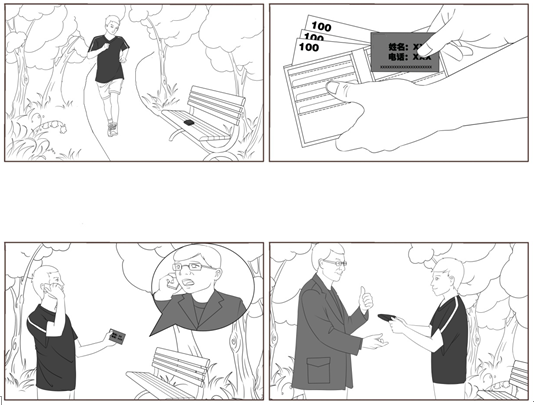
注意:
1.日记的开头已为你写好。
2.词数不少于60。
Saturday, May 3 Fine
This morning, ___________________
北京市西城区2014年高三二模试卷参考答案及评分标准
第一部分:听力理解(共三节,30分)
第一节(共5小题;每小题1.5分,共7.5分)
1.C 2.A 3.A 4.B 5.C
第二节(共10小题;每小题1.5分,共15分)
6.B 7.A 8.C 9.A 10.B
11.A 12.C 13.C 14.B 15.C
第三节(共5小题;每小题1.5分,共7.5分)
每小题1.5分。如出现拼写错误不计分;出现大小写、单复数错误扣0.5分;如每小题超过一个词不计分。
16.Maexner
17.night/day
18.two/2
19.March
20.85
第二部分:知识运用(共两节,45分)
第一节 单项填空(共15小题;每小题1分,共15分)
21.C 22.B 23.A 24.B 25.A
26.D 27.B 28.D 29.C 30.D
31.B 32.C 33.B 34.C 35.A
第二节 完形填空(共20小题;每小题1.5分,共30分)
36.C 37.D 38.D 39.A 40.B
41.C 42.A 43.B 44.B 45.D
46.C 47.C 48.D 49.B 50.C
51.A 52.A 53.A 54.B 55.D
第三部分:阅读理解(共两节,40分)
第一节(共15小题;每小题2分,共30分)
56.B 57.A 58.D 59.D 60.A
61.B 62.D 63.A 64.A 65.C
66.B 67.C 68.C 69.D 70.C
第二节(共5小题;每小题2分,共10分)
71.A 72.F 73.E 74.G 75.C
第四部分:书面表达(共两节,35分)
Dear Tom,
I know you love Chinese paintings. Here is a piece of good news for you. There will be an exhibition of Zhang Daqian’s paintings at the National Art Museum of China from May 10st to 25th. As you know, Mr. Zhang, one of the most famous Chinese painters of the 20th century, was a master at many types of painting, especially landscapes. The coming exhibition will be composed of more than 100 of his masterpieces. I believe it will be a great time for all his fans. Don’t miss it.
If you need further information, just let me know.
Yours,
Li Hua
第二节(20分)
One possible version:
Saturday, May 3 Fine
This morning, I was jogging in the park when I caught sight of a wallet on a bench. Clearly, someone had left it there by accident. I picked it up and checked the contents. Inside it, I found some money and a card with a phone number. Believing that the owner would be worried, I immediately tried the number. A man answered it in an anxious voice. Hearing that I had his wallet, he sighed with relief and told me he would return right away. Ten minutes later, the man arrived. After confirming he was the owner, I handed the wallet back to him. With his thumb up, he expressed his gratitude to me repeatedly. Seeing the smile on his face, I felt happy that I was able to help.


