(单词翻译:单击)
If you’re watching this video, keep your eyes peeled.
如果你正在收看这个视频,一定要睁大眼睛。
We’ve got a missing star and the search is on.
有一颗星星失踪了,我们还在搜索。
And its disappearance might be connected to a bit of physics we’ve never seen before.
它的消失可能与一些我们从未见过的物理学有关。
This strange situation was laid out last week in a paper published in the Monthly Notices of the Royal Astronomical Society.
上周,发表在《皇家天文学会月报》上的一篇论文提到了这个奇怪的现象。
It describes more than a decade of observations of the Kinman Dwarf Galaxy, a small collection of stars about 75 million light-years away.
它描述了10多年来对金曼矮星系的观测,金曼矮星系是一个距离我们7500万光年的小恒星群。
Because it’s so far away, not even our most powerful telescopes can make out individual stars within the galaxy.
因为它离我们非常远,即使是最强大的望远镜也无法分辨出银河系中的单个恒星。
Instead, astronomers use a technique called spectroscopy to look at the chemical makeup of the galaxy and search for outliers that might indicate something interesting is going on.
于是,天文学家使用一种叫做光谱学的技术来观察星系的化学组成,并寻找可能表明正在发生一些有趣的事情的异常值。
And in observations starting in 2001, they identified the signature of an extremely rare kind of star.
在2001年开始的观测中,他们发现了一种极其罕见的恒星的特征。
It’s called a luminous blue variable, or LBV, which is the last stage of life for some of the universe’s biggest stars.
它被称为发光蓝色变星,简称LBV,这是宇宙中一些最大的恒星生命的最后阶段。
And this thing is bright: the paper estimates that it’s around 2.5 million times brighter than our Sun.
它非常亮:这篇论文估计它比太阳还要亮250万倍。
So, scientists were intrigued by it, and between 2001 and 2011, teams of researchers observed this galaxy to try to learn more about this strange star.
因此,科学家们对它很感兴趣,在2001年到2011年之间,研究小组观察了这个星系,试图了解更多关于这颗奇怪的恒星的信息。
And that’s exactly what the authors of last week’s paper were trying to do, as well.
这也是上周发表论文的作者们的目的。
Except, in 2019, when they pointed the European Southern Observatory’s Very Large Telescope in the direction of the Kinman Dwarf Galaxy, the signature of the LBV was just gone.
不过,在2019年,当他们将欧洲南方天文台的超大望远镜转向金曼矮星系的方向时,LBV的信号就消失了。
Normally, LBVs end their lives in massive supernova explosions, but astronomers almost certainly would’ve noticed that, because, even that far away, a supernova would be bright enough to pick out with a telescope.
正常情况下,LBV会在超新星大爆炸中结束它们的生命,但天文学家肯定会注意到这一点,因为即使距离如此遥远,超新星也足够明亮,用望远镜就能看出来。
So the fact that it just vanished is bizarre.
所以它消失的很奇怪。
And, like any good whodunnit, there are a few possible explanations.
而且,就像优秀的侦探小说一样,这种现象可能有几种解释。
The most straightforward is that the star just suddenly got dimmer.
最直接的原因是恒星突然变暗了。
After all, the “V” in LBV stands for “variable,” as in variable brightness.
毕竟,LBV中的“V”代表“可变”,就像亮度可变一样。
So it’s possible that it got a little dimmer, and maybe also got obscured by a cloud of dust at the same time.
所以它有可能变暗了,也可能是被一团尘埃遮蔽了。
The second option, which is definitely more exciting, is that the LBV is now a black hole.
第二种可能更令人兴奋,那就是LBV现在变成了一个黑洞。
Normally, a supernova has to happen before you get a black hole, but physicists have hypothesized that, under the right circumstances,
通常情况下,超新星爆发之后才会出现黑洞,但物理学家假设,在适当的情况下,
it may be possible for a massive, unstable star to collapse directly into a black hole and basically just vanish.
一颗质量巨大、不稳定的恒星可能会直接坍缩成黑洞,基本上就消失了。
Astronomers have never seen such a thing, but if it happened, it might look a lot like what we see here.
天文学家从未见过这样的事情,但如果它发生了,就很可能像现在这种情况。
Of course, it’s still possible that the star actually did explode in a supernova and we just missed it.
当然,也有可能是这颗恒星确实在超新星中爆炸,但我们却错过了它。
These days, automated supernova monitoring makes that pretty unlikely, but the authors acknowledge that the star could have gone supernova sometime before we started regularly observing it in 2001.
如今,自动超新星监测基本避免了这种情况,但作者承认,这颗恒星可能在我们2001年开始定期观测之前的某个时候已经变成了超新星。
If that were the case, the bright signal they saw between 2001 and 2011 may have come from interactions between the expanding supernova and the gas surrounding it.
如果是这样的话,他们在2001年到2011年间看到的明亮信号可能来自膨胀的超新星与其周围气体之间的相互作用。
With so many possibilities, it’ll take a lot more observations to figure out which one is right.
有这么多的可能性,我们需要更多观察才能知道哪种是正确的。
But, if this giant star really did collapse into a black hole, you can be sure that we’ll never see it again.
但是,如果这颗巨星真的坍缩成黑洞,我们肯定再也见不到它了。
In other space news, planetary scientists recently used NASA’s Lunar Reconnaissance Orbiter to learn something surprising about the Moon’s composition, and the answer might help fill in details about how the Moon was formed.
在其他太空新闻中,行星科学家最近利用美国宇航局的月球勘测轨道飞行器了解了一些关于月球组成的令人惊讶的事情,而答案或许能补充月球形成的细节。
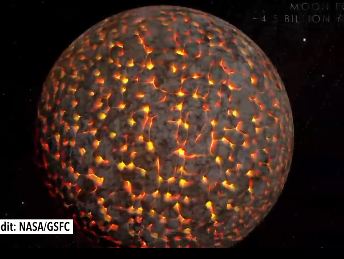
It’s now widely accepted that the Moon formed as a result of a massive collision between our young Earth and a Mars-sized object.
目前人们普遍认为,月球是在年轻的地球与火星大小的物体发生大规模碰撞后形成的。
But the details aren’t all that clear.
但具体细节还不是很清楚。
Like, how much of the Moon is made of Earth-stuff versus material from the object that hit it?
比如,月球有多少是由地球物质构成的,有多少是由撞击它的物体产生的物质构成的?
Since the collision happened billions of years ago, computer simulations are the main tool scientists use to test out scenarios.
由于碰撞发生在数十亿年前,科学家们只能通过计算机模拟来测试各种场景。
And to make a good simulation, you need to know as much as possible about the basic structure of the Moon.
为了做出一个好的模拟,你需要尽可能多地了解月球的基本结构。
Last week, work published in the journal Earth and Planetary Science Letters revealed a new detail about a place we don’t know that much about: the interior of the Moon’s crust.
上周,发表在《地球与行星科学快报》上的一项工作揭示了一个我们知之甚少的地方的新细节:月球地壳内部。
The discovery was actually an accident.
这一发现实属意外。
The team was trying to use LRO’s radar instrument to search for evidence of water in lunar craters.
该小组试图使用LRO的雷达设备寻找月球陨石坑中有水的证据。
One way to do that is by examining particles on crater floors, looking for changes in a property called relative permittivity.
其中一种方法是检查陨石坑底部的粒子,寻找一种叫做相对介电常数的性质的变化。
Permittivity describes how easily electric fields can travel through a material.
介电常数描述了电场在物质中传播的难易程度。
And while mapping the permittivity of crater floors using radar, the researchers noticed something unusual.
在使用雷达探测陨石坑底部的介电常数时,研究人员注意到一些不寻常的现象。
The larger a crater was, the higher the permittivity seemed to be on the floor, but only to a point.
陨石坑越大,地板上的介电常数似乎也就越高,但只到达某个程度。
For craters bigger than about five kilometers across, the value seemed to level off.
对于直径大于5公里的陨石坑,这个数值似乎趋于稳定。
After considering several possibilities, the team concluded that the varying permittivity was telling them that the floors of the larger craters had more metallic compounds.
在考虑了几种可能性之后,研究小组得出结论,不同的介电常数表明,更大的陨石坑底部有更多金属化合物。
Which might seem weird, because what’s special about wider craters?
这似乎很奇怪,毕竟更宽的陨石坑能有什么特别之处呢?
But they’re not just wider. They’re also deeper.
但它们不仅更宽。而且也更深。
So, the results are really suggesting that the deeper you go into the Moon’s crust, the more metal you find, until about 500 meters below the surface.
所以,研究结果表明,在月球表面下500米处,你进入月球地壳越深,发现的金属就越多。
There, the metal content seems to level out at a fixed value.
在那里,金属含量似乎稳定在一个固定的值。
Now, on its own, this doesn’t tell us much about the origin of the Moon.
现在,它本身并不能告诉我们月球的起源。
But it could help scientists refine their simulations.
但它可以帮助科学家改进他们的模拟。
Because if your simulation has to create a body with lots of iron and titanium right under the surface, that’s a pretty specific constraint,
因为如果模拟必须在表面下创建一个含有大量铁和钛的物体,这个限制非常具体,
and it could help future simulations narrow down the possible collision scenarios.
它可以帮助未来的模拟缩小可能的碰撞场景。
It’s no interstellar whodunnit mystery, but sometimes the trickiest puzzles are the ones closest to home.
这不是星际侦探小说,但有时最棘手的谜题恰恰也是最接近现实的。
Thanks for watching this episode of SciShow Space News!
感谢收看本期太空科学秀!
And if you’re up for learning about another cosmic mystery, you might like our episode on the so-called Great Attractor, which is truly one of the biggest mysteries out there.
如果你想了解更多宇宙之谜,你可能会喜欢我们关于所谓的巨引源的那一集,这才是真正的最大谜团之一。
You can watch that next!
接下来你就可以收看那个视频!


