(单词翻译:单击)
The Hubble Space Telescope literally changed the way we see the universe.
哈勃太空望远镜确实改变了我们看待宇宙的方式。
Since it launched in 1990, thirty years ago this year,
自从1990年,也就是30年前的今天,
it’s snapped more than a million images, from close-ups of nearby planets to the farthest galaxy ever detected.
它拍摄了超过一百万张照片,从附近行星的特写到迄今为止所发现的最远的星系。
Chances are, most of the iconic space pictures you’ve seen have come from Hubble.
很有可能,你看到的大多数标志性的太空图片都是哈勃拍摄的。
But those images aren’t just stunning and beautiful;
但这些照片并不只是令人惊叹和美丽;
they’ve also shaped the way we imagine and study space.
它们也塑造了我们想象和研究太空的方式。
They’ve let us measure the universe’s age, have shown us that the universe’s expansion is accelerating,
它们让我们得以测量宇宙的年龄,让我们知道宇宙正在加速膨胀,
and have given us a look at planets around other stars.
让我们看到了其他恒星周围的行星。
Here’s why this telescope is so good at creating them.
接下来我会告诉大家这个望远镜这么厉害的原因。
First, Hubble has a leg up by being in space.
首先,哈勃在太空中如虎添翼。
Since it doesn’t have to deal with turbulent air molecules, which blur light,
因为它不需要处理使光线变得模糊的湍流空气分子,
it can pick out details more than ten times sharper than the best telescopes on the ground.
它可以分辨出比地面上最好的望远镜还要清晰十倍以上的细节。
On top of that, it can detect wavelengths that Earth’s atmosphere blocks out altogether, like UV rays.
最重要的是,它可以探测到被地球大气层阻挡的所有波长,比如紫外线。
That lets us see lots of things, like newly forming stars and matter spiraling into black holes, that we can’t see the same way from Earth.
这让我们看到很多东西,比如新形成的恒星和螺旋状进入黑洞的物质,这些东西在地球上是看不到的。
In fact, Hubble can pick up wavelengths both longer and shorter than visible light!
事实上,哈勃望远镜可以捕捉到比可见光更长和更短的波长!
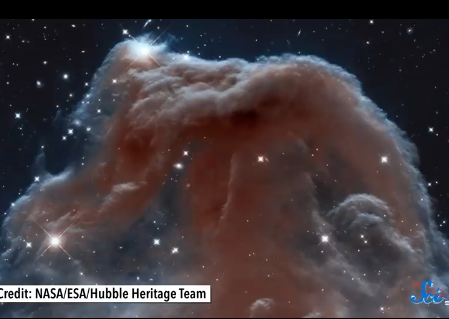
Turning all of those wavelengths into a pretty picture, though, is a whole other story,
不过,把所有这些波长转换成一幅漂亮的图画,就是另一回事了,
because no matter what Hubble can see, our eyes can still only see things in the visible spectrum.
因为不管哈勃能看到什么,我们的眼睛仍然只能看到可见光范围内的东西。
And it takes some processing to turn raw Hubble data into a color photo.
它需要一些能把原始的哈勃数据变成一张彩色照片的处理过程。
As a first step, Hubble actually gathers all its raw data in black-and-white.
第一步,哈勃实际收集的所有原始数据都是黑白的。
It has filters that only let through light at specific wavelengths, and when photons, or particles of light,
它有过滤器,只允许特定波长的光通过,当光子,或光的粒子,
pass through, an electronic detector records where they land.
通过时,一个电子探测器会记录它们降落的地方。
So you end up with a pattern of photons from a single wavelength,
所以你最终得到的是一个单一波长的光子图案,
which translates into a black-and-white image.
也就是黑白图像。
But since different astronomical phenomena emit different kinds of light,
但是由于不同的天文现象会发出不同的光,
a single wavelength usually won’t give you a complete picture.
单一波长通常不会有完整的画面。
For instance, if you look at the nearby Triangulum Galaxy at X-ray wavelengths, you’ll see mostly interstellar gas.
例如,如果你在x射线波长下观察附近的三角座星系,你会看到大部分星际气体。
At UV wavelengths, you’ll see regions of star formation.
在紫外波段,你会看到恒星形成的区域。
The visible spectrum will show you the stars.
可见光谱能让你看到恒星。
And radio waves will give you a map of hydrogen gas.
无线电波会让你看到一张氢气图。
In other words, each wavelength tells a totally different story!
换句话说,每个波长展示出来的是完全不同的画面!
So Hubble records a bunch of black-and-white images at different wavelengths.
哈勃记录了一组不同波长的黑白图像。
Then it’s time to put them together and add color.
然后就是把它们放在一起,并添加颜色。
Astronomers assign colors to each of the wavelengths of light.
天文学家给每个光的波长分配颜色。
If all the wavelengths fall in the visible spectrum, they can assign each wavelength its true color.
如果所有的波长都在可见光谱中,他们就可以给每个波长分配其真正的颜色。
But often, they’re dealing with wavelengths we wouldn’t ordinarily be able to see.
但通常,他们处理的是我们一般看不到的波长。
In those cases, astronomers assign those invisible wavelengths a color from the visual spectrum.
在这种情况下,天文学家把那些可见光谱中的不可见波长指定为一种颜色。
They might color all X-rays shades of blue, for example.
例如,他们可能会把所有x射线都染成蓝色。
The colors they choose can help them highlight features or subtle details in the targets they’re exploring.
他们选择的颜色可以帮助他们突出正在探索的目标的特征或微妙的细节。
And it might not be exactly what you’d see if your eyes were as powerful as Hubble, but as surreal as it looks, it’s all based on real data.
如果你的眼睛像哈勃一样厉害,你看到的景象可能并不是这个样子,但尽管看起来如此超现实,它都是基于真实的数据。
Finally, part of the reason these images are so stunning in the first place is because Hubble collects incredible data.
最后,这些图像如此令人惊叹的部分原因是哈勃收集了令人难以置信的数据。
Many of Hubble’s sources are really faint, so it takes a long time to collect enough light to produce a meaningful picture.
哈勃望远镜的许多光源都非常微弱,因此需要很长时间才能收集到足够的光线,才能拍出有意义的照片。
And in a way, there’s nothing novel about how Hubble does that:
从某种程度上说,哈勃的做法并不新奇:
It collects light a lot like a camera does during a long exposure except...
它像照相机在长时间曝光时那样收集光线,除了……
it’s also hurtling around the Earth at about 8 kilometers a second, trying to stay focused on a single speck the whole time.
它还以每秒8公里的速度绕着地球飞行,试图在整个过程中只聚焦于一个小点。
Since it’s not just sitting still like a camera normally would be, it needs to be able to point really precisely over and over and over again, often hundreds of times, as it zooms through its orbit.
因为它不像相机那样静止不动,它需要能够精确地一遍又一遍,经常是数百次地,在它的轨道上快速移动。
To do that, it has special tools called fine guidance sensors.
为了做到这一点,它有一种叫做精密制导传感器的特殊工具。
Two of these super-sensitive detectors lock onto bright stars, or guide stars, on either side of the target Hubble’s aiming to photograph.
其中两个超灵敏的探测器锁定在“哈勃”拍摄目标两侧的明亮恒星上,或引导恒星。
Then, forty times a second, they lock back onto the guide stars to make sure Hubble’s position stays sharp.
然后,它们以每秒40次的速度锁定在引导恒星上,以确保哈勃的位置保持精准。
For most observations, Hubble also has to deal with the fact that Earth gets in the way of what it’s trying to see.
对于大多数观测来说,哈勃还必须面对这样一个事实:地球挡住了它的视线。
Every 45 minutes or so, as Hubble orbits the Earth, our planet eclipses its target.
当哈勃环绕地球运行时,每隔45分钟左右,我们的星球就会使它的目标黯然失色。
When that happens, the cameras shut down until the telescope comes out the other side.
当这种情况发生时,摄像机就会关闭,直到望远镜从另一侧出来。
At that point, the fine guidance sensors have to quickly snap back onto the original guide stars and bring the target back into focus.
这时候,精密制导传感器必须迅速返回至原来的引导恒星上,并重新聚焦在目标上。
And these sensors are so good at what they do that Hubble is extremely stable, and it can focus on really faint, distant objects with hardly any blur.
这些传感器的性能非常好,使得哈勃非常稳定,它可以很清晰地聚焦到非常模糊的遥远物体上。
Like, if your eyes were as good as Hubble, and you stood in Washington, D.C. looking at Tokyo, you’d be able to make out two fireflies just 3 meters apart.
比如,如果你的眼睛和哈勃一样好,你站在华盛顿特区看东京,你可以分辨出相距3米的两只萤火虫。
So, Hubble has some really impressive tricks for creating the pictures it’s so famous for.
所以,哈勃有一些令人印象深刻的技巧来拍摄出如此著名的图片。
And it helped usher in a whole generation of space telescopes that use similar tools to study the universe in different ways.
它还引领了整整一代使用类似工具、以不同方式研究宇宙的太空望远镜的诞生。
But even as it ages, Hubble has remained iconic.
但即便在寿终正寝的时候,哈勃依然是个标志。
Its images have reached way past NASA into the everyday world, where they’ve been inspiring people for decades.
它的形象已经超出NASA,进入到人们的日常生活中,几十年来一直激励着人们。
And they’ve also had an important scientific role.
它们在科学上也扮演着重要的角色。
They’ve helped us understand the complex stories each wavelength tells about an astronomical object, and how those stories are intertwined.
它们帮助我们理解每个波长体现的一个天体的复杂故事,以及这些故事是如何交织在一起的。
For instance, the iconic image called Pillars of Creation is a nebula full of stars being born.
例如,被称为“创造之柱”的标志性图像是一个充满诞生恒星的星云。
But the optical and UV starlight we’d normally see gets absorbed by dust and re-emitted in infrared.
但我们通常看到的可见光和紫外光会被尘埃吸收,然后以红外线重新发射出去。
Hubble picked up that infrared light, and by creating an image that combined different wavelengths,
哈勃望远镜捕捉到了红外线,通过合成不同波长的图像,
astronomers could actually see how many stars were inside the nebula and how they were interacting with clouds inside the pillars.
天文学家可以看到星云内部有多少颗恒星,以及它们是如何与柱状星云内部的云相互作用的。
They were able to do a similar thing with the star Eta Carinae, which shines at us from the Great Carina Nebula, one of the largest star-forming regions in our galaxy.
他们能够对海山二星做类似的事情,它来自船底座大星云,是我们星系中最大的恒星形成区域之一。
Colored photos bring out the features of this star and its environment and let us see the dust, gas, and newly forming stars.
彩色照片展示了这颗恒星的特征和它的环境,我们能看到尘埃、气体和新形成的恒星。
Our Sun and solar system may have come out of a system a lot like this,
我们的太阳和太阳系可能是从一个类似的系统中诞生的,
so having the chance to explore this star and its nebula this way gives us a fascinating window into our own possible origins.
所以有机会以这种方式探索这颗恒星和它的星云,给我们提供了一个了解我们自己可能起源的迷人窗口。
And if nothing else, it shows us what star formation is like in the dense spiral arms of our galaxy.
如果没有别的,它向我们展示了在我们星系的密集旋臂中恒星的形成。
Whether they’re informing complex ideas about where we came from or making images of galaxies mainstream, Hubble’s photos have shaped the way a lot of us imagine space.
不管它们是在告诉我们人类起源的复杂想法,还是让星系的图像成为主流,哈勃的照片已经塑造了我们许多人想象太空的方式。
They’ve given us three decades’ worth of science, and they still have a lot to offer our research and imagination.
它们给了我们价值三十年的科学,他们仍然有很多东西可以提供给我们研究和想象。
This episode wouldn’t have been possible without the team at NASA’s Goddard Space Flight Center, who provided a lot of the information we used.
如果没有NASA戈达德太空飞行中心的团队,我们不可能制作出这一集的内容,他们提供了大量信息。
And we’d like to give a special thanks to Jim Jeletic, Ken Carpenter, Joe Depasquale, Mike Wenz, Erin Kisliuk, and Courtney Lee.
我们要特别感谢Jim Jeletic, Ken Carpenter, Joe Depasquale, Mike Wenz, Erin Kisliuk和Courtney Lee。
We’d also like to thank our patrons on Patreon, who make it possible for us to share amazing science like this.
我们还要感谢Patreon的粉丝,是他们让我们能够分享这样令人惊叹的科学。
It takes a lot of people to make a SciShow video, and we couldn’t do it without your support.
制作《科学秀》的视频需要很多人,没有你们的支持,我们无法完成。
If you’re not a patron but would like to help us keep SciShow going, you can learn more at patreon.com/SciShow.
如果你不是我们的粉丝,但想帮助我们继续制作《科学秀》,请登录patreon.com/SciShow了解更多。
And, as always, thanks for watching SciShow Space.
一如既往地感谢大家收看太空科学秀。


