(单词翻译:单击)
Hi. Welcome to www.engvid.com. I'm Adam.
嗨,欢迎来到www.engvid.com.我是亚当。
Today's lesson is going to be a bit of a mix of grammar, and vocab, and writing-all of the skills you need together
今天这节课我们要讲的内容涉及到语法、词汇和写作,都是大家需要用到的技巧。
because we're going to be looking at suffixes; and more specifically, we're going to be looking at seven words that can also be used as a suffix.
今天我们要讲的是“后缀”,确切地说,今天我们要来讲7个可以用作后缀的单词。
Now, first of all, what is a suffix?
首先,什么是后缀?
A suffix is a piece of something that you add to the end of a word. It's a word ending. Right?
“后缀”就是加在单词后面的那一部分,是单词的尾巴,懂了吗?
Now, most of you might be familiar, for example, with if I add ly to the end of an adjective, I can change it into an adverb;
现在,大部分的人可能都知道,比如,如果在形容词后面加上“ly”,那么这个形容词就会变成副词。
or if I add ment to the end of a word, I make it a noun.
或者如果在一个单词的后面加上“ment”,那么这个单词就会变成名词。
Now, these suffixes change words in terms of parts of speech. I change a verb to a noun or a noun to a verb, etc.
这些后缀改变了单词的词性,把动词变成了名词,或者把名词变成了动词,等等。
What these do... what these specific suffixes do is they change the meaning of a word completely.
而(我们今天要讲的)这些后缀做到的……这些特定的后缀做到的,就是它们彻底改变了单词的意思
Now, the reason it's important to know these and the reason I mentioned writing is because these are not used enough by writers;
知道这些很重要,原因就是,我提到过的关于写作,就是这些没有被同学们充分利用。
especially those of you taking tests, like IELTS, TOEFL, CAE, etc.
尤其是那些参加雅思、托福、CAE等考试的同学。
-you need to have your vocabulary range. Right? That's one of the things they're scoring you on.
你要有自己的词汇范围,对吧?这是他们给你打分的标准之一。
You want to have nice words, but nice words don't have to be big words; they just have to be words that are not commonly used.
你想写出漂亮的词,但是漂亮的词不一定就是那些高大尚的词,它们可以是那些不常用到的词。
And a lot of people do not use words that include these suffixes, and they're very useful words. Okay? So we're going to look at some of them.
很多人都不会用到这些含有后缀的词,但是这些词真的非常有用,懂吗?所以我们今天就要来讲讲。
So, when I add hood to the end of a word, for example... now,
所以,如果我在某个单词的后面加上“hood”,比如
the word hood by itself, if you have a hoodie, if you have a sweatshirt with a hood that goes over your head;
“hood”这个单词本身,如果你有一件“hoodie(连帽衫)”,如果你有一件带“hood(兜帽)”的运动衫,
or if you think about in your kitchen you have a... you have your stove,
或者你想在你的厨房里,有一个……有一个炉子,
and above it you have a hood with a fan to take all the steam and oil, or whatever you're cooking-the smells.
在炉子上面有一个带风扇的“hood(排气罩)”,用来吸所有的蒸汽和油或者你正在煮的东西的气味。
Your car, the front of your car, over your engine has a hood.
你的车,车的前面,引擎上会有一个“hood(引擎盖)”。
So, think of a hood as covering everything.
所以,把“hood”想成可以囊括一切的这么一个单词。
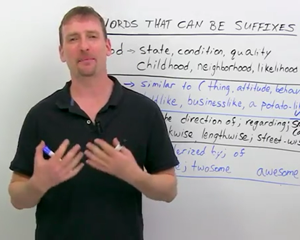
But as a suffix, it's basically the state, condition, or quality of something.
但是作为一个后缀,它大概的意思就是指“某物的状态、条件或者质量”
So, now, for example, when I speak of childhood, I'm talking about the whole time of being a child and everything that is included in that.
现在我们来举个例子,当我说到“childhood(童年时期)”这个单词,意思就是“以孩子的身份度过的所有的时间以及这段时间里发生的所有的事情”
So, childhood includes going to school and having friends, and playing outside, and having toys, and having... playing video games, and innocence.
所以,“childhood(童年时期)”就包括了“上学、交朋友、出去玩儿、玩玩具、……玩电子游戏、还有那种纯真”。
All of the ideas we think of: What is a child? are included in the childhood; so it's a period of time where you're a child.
所有我们能联想到的:“child(儿童)”这个词是什么?它是单词“childhood”的一部分,所以说“childhood”指的就是“你在当儿童的这段时间”。
The opposite: adulthood-the time of being an adult; of having a job, and having a family, and responsibilities. Okay?
与之相反的是:“adulthood(成人期)”——作为成人的这段时间,有了工作,有了家庭,有了责任,对吧?
A neighbourhood is the area where all the people are neighbours; where all the neighbours live together and share a small community. Okay?
“neighbourhood(街区)”指的就是“所有人都是邻居的这么一块儿地方,在那里所有的邻居都住在一起,共享一个小社区,对吧”,
Likelihood. Likely means probably will happen.
“likelihood(可能性)”,“Likely”的意思是“可能发生的”
The likelihood means the chance of something being likely; the chance of it being... or the condition of it being likely.
“likelihood”指的就是“某件事情成为可能的几率,什么什么的几率……或者成为可能的条件”。
So, the likelihood of this guy winning the presidency is very low.
所以可以说:“这个人当选总统的可能性非常低”。
But turns out that the likelihood was not as low as everybody expected, for example. Right?
但是事实证明,这种可能性并不像所有人预期的那么低,对吧?
Now, the reason I mentioned these: I've seen so many IELTS and TOEFL essays that do not use this word that should use this word. Right?
我讲这些词的原因是:我看到过很多的雅思和托福作文里该用到这些词的时候却没有用到。
People say: Oh, the time that a person is a child... the time a person is a child, right?
他们都是这么写:“Oh, the time that a person is a child(谁谁是孩子的那段时期)……the time a person is a child”,是吧?
You have seven words when you could have said all of that with one word. If you can use one word, don't use seven words. Okay?
你本可以用1个词就能表达的意思却用了7个词,所以如果你能用1个词,那就不要用7个词,明白了吗?
So now we're talking about coherence and cohesion, which includes brevity.
所以现在我们讲的是“连贯”和“衔接”,里面包括“简洁性”。
These suffixes give you a lot of range in terms of vocabulary. Learn how to use them properly.
这些后缀可以扩大你的词汇范围,要学会如何恰当地使用它们。
Lots of words like this. If you Google: Words that end in 'hood', you'll see a whole bunch of them. Okay?
这样的词很多,如果你谷歌一下“结尾是‘hood’的单词”,那么你会看到很多这样的词。对吧?
Like. So, like has many meanings, but the one we're going to look at is similar to; so something is like something else.
“like”,“like”的意思有很多,我们要来讲的是它“像”的这个意思,什么东西像什么东西。
But I don't have to separate it into a whole sentence; I can use this as a suffix.
但是我不需要把它单独用在一个句子里,我可以把它用作后缀。
I can talk about things, attitudes, behaviours, but you have to be a little bit careful. Okay?
我们可以用它来谈论“事情、态度、行为”,但是用的时候必须小心,好吧?
Now, if somebody is childlike means he is like a child.
如果说某人是“childlike(孩子似的)”,意思就是说“他像小孩儿一样”。
But what does that mean? It doesn't mean that he's small or whatever; it means he behaves like a child or he thinks like a child.
不过具体是什么意思呢?并不是说他像小孩一样小还是什么,而是说他的行为举止像个小孩或者说他的想法像个小孩。
So, we're not talking about physical; we're talking about mental or even personality-wise. And we're going to talk about wise in a second.
所以我们指的不是“身体上”的像,而是“思想上”或者可以说是“人格上”的像,待会我们还会讲到“wise”。
Businesslike. So, in my company, I don't allow jeans. Everybody has to dress in a businesslike manner;
“businesslike(公事公办的)”,所以,在我的公司,我不允许员工穿牛仔裤,每个人都必须穿着得体。
everybody has to come with a businesslike attitude-they have to be like a business.
每个人都必须有“businesslike(公事公办的)”的态度,他们必须像一个职员。
They have to act or their attitude has to be business; not casual. Right?
他们的行为举止或者他们的态度必须是职员该有的,而不是随意怎么来,懂了吗?
I want everybody to be very businesslike when they meet clients.
我希望任何人在跟客户见面时都能公事公办。
Don't pretend like they're your best friends; be businesslike, get the job done, move on.
不要假装你们是你最好的朋友什么的,必须公事公办,把工作做好,前进。
Now, if you want to compare physical things, right?
嗯,如果你想对“物理上的”东西进行比较,对吧?
So, everybody knows what a sweet potato is-okay, or a yam. Okay? Do you know a yam?
所以,大家都知道“地瓜”是什么,嗯,或者“yam(甘薯)”,好吧?你知道什么是“yam(甘薯)”吗?
A yam is a potato-like vegetable. So, it's similar to a potato, but it's not a potato.
“yam”是一种类似土豆的东西,所以,它只是和土豆像,但并不是土豆。
It's different, but very similar; starchy, you can bake it, you can eat it with sour cream. Very delicious. Okay?
它俩是不同的,但是很像,都含淀粉,都可以烤着吃,可以拌着酸奶油吃,很美味,是吧?
So, all of these things-again, Google: Words that end in 'like', you'll have a whole list of these. Good to know.
所以,所有这些单词,再来谷歌一下:“以‘like’结尾的单词”,你会看到一个完整的列表,嗯,很开心。
And again, you don't want to say something in five words that you could say in one. Okay.
再强调一遍,可以用1个词表达的意思就不要用5个词,好吧?
Wise. So, everybody knows wise: Oh, smart person.
“wise(明智的)”,大家都认识wise这个单词:“哦,聪明人”
Yeah, well, that's an adjective and we can use that in a different way than we can use the suffix.
没错,这是一个形容词,它不只可以当后缀,其他的用法也有。
As a suffix, it means in the direction of or regarding, in regards to.
作为后缀它的意思是“……的方向”或者“关于……、有关……”
So, when I want to turn clockwise, I want to turn this direction; counterclockwise-against.
所以,如果我想按照“clockwise(顺时针)”的方向转,我想按照这个方向。“counterclockwise(逆时钟方向的)”就是“反过来的”。
So, in the clockwise, in the direction of a clock; counterclockwise, the opposite direction.
所以,“clockwise”指的就是“按照时针的方向”;“counterclockwise(逆时钟方向)”指的就是“相反的方向”。
I'm not sure if this translate. Clockwise; counterclockwise. Okay?
我不确定这个翻译对不对,“clockwise”、“counterclockwise”,懂了吧?


