(单词翻译:单击)
Magnets can be created by running currents through wires,
电流通过电线可以产生磁性,
by finding a suitable material that naturally has all the magnetic fields of its atoms aligned, or by forcing the magneticfields of atoms to align.
通过找到一种所有原子磁场都是自然对齐的合适的材料,或通过迫使原子的磁场对齐的方式都可以产生磁性。
But there's one more kind of magnetism that all materials exhibit, even those whose constituent atoms aren't magnetic -
但所有物质都表现出另一种磁性,即使它们的组成原子没有磁性——
though it's so weak that the other kinds of magnetism often overwhelm it.
尽管它还很弱,其他种类的磁力经常会把它盖住。
Basically, an external magnetic field causes the electrons around atoms in a material to change course,
基本上,外部磁场使材料中原子周围的电子改变方向,
and their new motion generates an opposing magnetic field.
并且它们的新运动产生了一个相反的磁场。
This field is pretty weak, but it does cause the material to be repulsed from the magnet a little bit - for example,
这个磁场相当弱,但它确实导致该材料被磁铁排斥——例如,
if you hang a wooden toothpick in a magnetic field, the ends will repel the field and it will end up aligning across the magnetic field.
如果你把一根木制牙签挂在磁场中,它的两端会排斥磁场,最后会在磁场中对齐。
This is a convenient way to remember the name of this kind of magnetism - diamagnetism -
这是记住这种磁力名称的一种便捷方式——反磁性——
since 'dia' means across, like the 'diameter' measured across a circle.
‘dia’指的是穿过,就像是测量圆的直径。
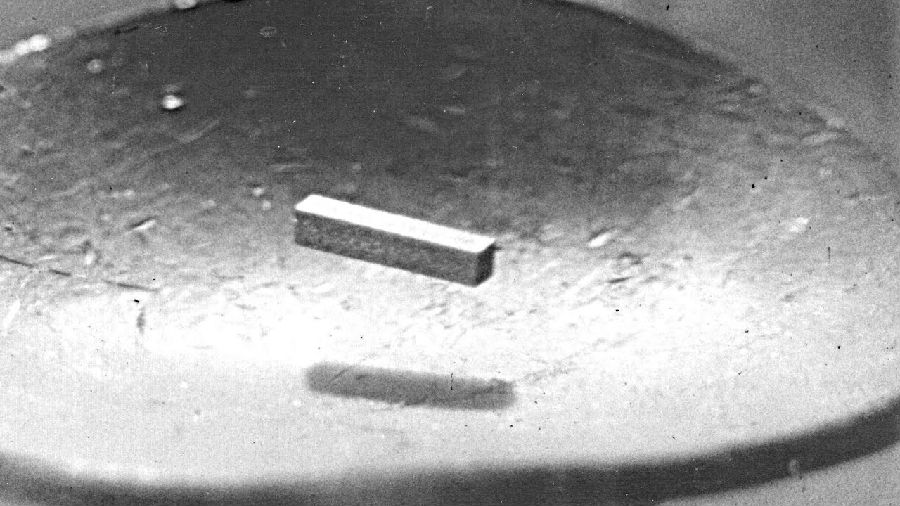
Diamagnetic materials will repel a magnet, and a diamagnetic 'compass' will point across the magnetic field - that is, it will orient east/west.
反磁性材料会排斥磁体,反磁“指南针”会指向磁场的另一端——也就是说,它会指向东/西。
As weak as it is, diamagnetism is pretty darn awesome because it's a repulsive effect: any diamagnetic material will levitate in a strong enough magnetic field!
尽管反磁性很弱,但它确实令人敬畏,因为它是一种排斥效应:任何反磁性材料都会在足够强的磁场中悬浮!
Like this chunk of graphene, or, since water is diamagnetic, this frog.
比如这块石墨烯,或是像这只青蛙,因为水是反磁性的。
In principle, humans could also be levitated this way, though the magnetic fields required would be enormous.
原则上,人类也可以通过这种方式悬浮,尽管所需的磁场将是巨大的。
There are also a lot of subtleties we've skated over, like the fact that nitrogen is diamagnetic even though as an atom it has unpaired electrons
我们还忽略了很多微妙之处,比如氮是反磁性的,尽管作为一个原子它有未配对的电子
- one might think that it should be at the very least paramagnetic.
——人们可能认为它至少应该是顺磁体。
But nitrogen atoms bond to form N2 molecules which have full outer electron shells and are thus only diamagnetic.
但是氮原子结合形成N2分子,它们有完整的外层电子壳,因此只有反磁性。
On the other hand, molecular O2, as we've seen, still has unpaired electrons, and it's paramagnetic.
另一方面,O2分子仍然有未配对的电子,它是顺磁性的。
You've probably also seen how superconductors can levitate in a magnetic field, which is a kind of perfect diamagnetism -
你可能也见过超导体如何在磁场中悬浮,这是一种完美的反磁性——
not only do the currents in a superconductor create opposing magnetic fields, they expel magnetic fields from the material entirely.
超导体中的电流不仅会产生相反的磁场,还会将磁场完全从材料中驱逐出去。
But the root cause is very very different, and that's a journey for another day.
但根本原因是非常非常不同的,而这就是另一段旅程了。


