(单词翻译:单击)
For more than forty years, the two Voyager probes have delighted us with information and pictures from across our solar system.
过去40多年来,旅行者号探测器为我们提供了关于太阳系的很多信息和图片,让人惊艳。
But now, they've embarked on a new mission.
不过,现在,旅行者号将注意力转到了一个新的任务上。
As of 2018, both probes had left the solar system and begun an interstellar journey — a quest to drift between the stars and take measurements wherever they go.
截至2018年,2个旅行者号探测器都已离开太阳系,开始了星际探索之旅——他们要在恒星之间周游并做测量工作。
But for as beautiful and poetic as that is, we can't expect this mission to go on forever.
虽然美丽动人又诗情画意,但我们不能期望任务永久进行下去。
Both Voyagers' clocks are ticking, and these days, they're running out of juice.
2个旅行者号的生命是有期限的。最近,它们的燃料也即将用尽。
Since they launched in 1977, these spacecraft have really earned their names, and so far, each has taken an epic journey of more than 17 billion kilometers.
它俩是1977年发射的,声名享誉全球,目前为止,每个旅行者号都已经走过了170多亿千米的史诗级旅程了。
On that journey, Voyager 1 visited Jupiter and Saturn, then crossed into interstellar space in 2012.
在这次旅程中,旅行者1号到访了木星和土星,然后于2012年进入了星际空间。
Meanwhile, Voyager 2 took a more scenic route that also passed Uranus and Neptune, so it only moved beyond the Sun's influence in 2018.
与此同时,旅行者2号所经之地风景更加靓丽——它经过了天王星和海王星,所以,2018年,旅行者2号才脱离地球的引力影响。
Right now, both craft are still transmitting data, and are measuring the interstellar environment with a suite of instruments.
现在,2个旅行者号依然在传输数据,也在用一套设备测量星际环境。
They're detecting magnetic fields, cosmic rays, and plasma waves.
他们正在探测磁场、宇宙射线、等离子体波。
But this isn't likely to last much longer, as the two sources of fuel the probes launched with are slowly running out.
但这些工作不太可能持续很久,因为2个探测器赖以运作的燃料在逐渐用完。
One of those fuels is hydrazine. This simple compound is typically used as a propellant for thrusters, since it's cheap and has a very low freezing point.
其中一种燃料是肼。这是一种简单的化合物,经常用作推进器的燃料,因为它成本低廉,冰点很低。
But in this case, it's not used to push the Voyagers along.
但就旅行者号来说,肼并不是推进它们发射的燃料。
They got their speed from their initial launch, plus gravity-assisted slingshots around the planets they visited.
旅行者号是通过初始发射来获取速度的,此外他们每次经过一些行星的时候,也会在引力的辅助下获得速度。
So instead, their hydrazine is used for trajectory correction and as an attitude control propellant to control the spacecrafts' orientation.
而肼是用来修正轨道的,同时也可以作为姿态控制的推进燃料,从而控制探测器的方向。
This helps correct for any rolls or tumbles, and keeps the probes pointed toward Earth, so they can beam back results and receive commands from mission control.
肼有助于修正错误的颠簸,保证旅行者号始终朝向地球。这样一来,他们才能传回结果并受到任务控制中心的指令。
These kinds of corrections only need to be made every once in a while, so the hydrazine isn't used up very quickly.
这些类型的修正只能偶尔发生,所以肼消耗的速度不是很快。
In fact, NASA estimates they're running at a fuel economy of about 13,000 kilometers per liter, which puts pretty much every other vehicle to shame!
实际上,美国宇航局(NASA)估测,每升肼可以支持1.3万公里的行程,这让其他探测器情何以堪!
But still… it has been 40 years since these things launched.
不过,毕竟旅行者号已经发射了40年。
So even though both Voyagers left Earth with 104 kilograms of hydrazine each, supplies are running low.
所以,即便当初发射的时候配有104公斤的肼,供给物的总量现在也不是很高了。
NASA reckons Voyager 1's hydrazine will last until 2040, but Voyager 2's will run out in 2034.
NASA认为,旅行者1号的肼可以用到2040年,而旅行者2号的肼将在2034年用尽。
That's because it used up more of its supply maneuvering around Uranus and Neptune.
这是因为旅行者2号在天王星和海王星附近周旋的时候,用掉了更多的供给物。
After that, the craft will keep speeding through interstellar space, but they might not be pointing in the right direction to send back results.
在那之后,旅行者2号在星际空间中持续加速穿梭,所以可能朝向地球的方向不够准确,无法发送回结果。
So we'll likely have to say goodbye. 2034 and 2040 might seem like a long time from now, but sadly, the Voyagers will probably go silent before then.
所以,我们很有可能要跟它说再见了。2034年和2040年可能看起来距离现在很遥远,但不幸的是,这2个旅行者号很有可能在那之前就不再发回数据了。
Because as well as liquid fuel, the probes have another power source, one that makes electricity for its onboard systems.
因为除了液态燃料之外,这2个探测器还需要另一种能源,为星载系统发电的燃料。
It's called a radioisotope thermoelectric generator, or RTG.
即,放射性同位素热电式发电机(RTG)。
And the ones in the Voyagers are on their last legs.
而2个探测器上的RTG已经处于暮年。
RTGs work by generating heat. And they do this thanks to their four and a half kilograms of plutonium dioxide.
RTG是通过产热来工作的,具体来说是要靠4.5公斤的二氧化钚。
Like other radioactive compounds, this stuff is unstable.
跟其他放射性化合物相似,这个物质也不稳定。
So over time, the plutonium atoms decay, breaking down into smaller particles and more stable uranium atoms.
所以,随着时间的流逝,钚原子会衰变,会分解成更小的粒子和更稳定的铀原子。
This decay process gives off heat, which the RTGs are able to convert into electricity.
衰变的过程会放热,RTG会将发出的热量转化成电能。
Both Voyagers were fitted with three of these generators, which together provided about 470 watts of power at launch.
但旅行者号上有3个这样的产热器,它们加在一起可为发射提供近470瓦的能量。
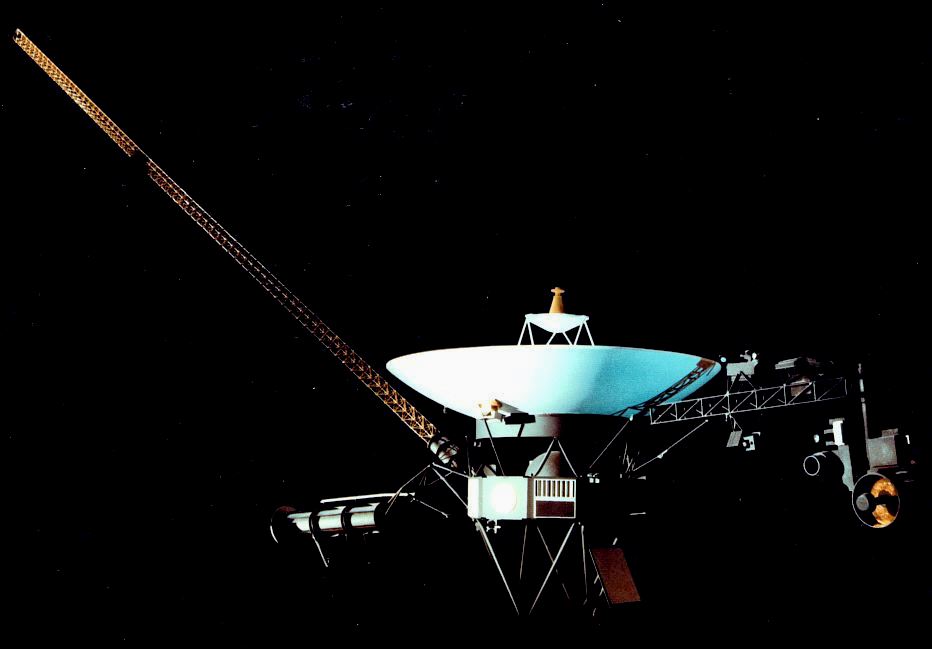
It doesn't sound like much — your average toaster uses more than 1000 watts — but it was enough to power the central computer, communications equipment, and a suite of ten instruments.
虽然听起来不多——但其实烤箱的平均吸热量达1000多瓦——但这个热量足以支持中央计算机、通信设备、包含10个设备的一套设备来运作了。
Unfortunately, at this point, a large portion of the plutonium has decayed away.
不幸的是,目前,许多钚已经衰变了。
What's left is only able to provide about 250 watts.
剩下的钚只能提供大概250瓦的能量了。
So, to conserve that power for the probe's more critical functions, scientists have — one by one — started shutting down the probes' instruments.
所以,为了将这些能量用在关键功能上,科学家已经——一个接一个地——开始关闭探测器上的设备了。
For Voyager 1, they started with the cameras and heaters in 1990.
就旅行者1号来说,一开始,也就是1990年的时候,是有摄像机和发热器的。
Then, 20 more components followed over the years.
随后,20多个组件相机关闭。
Voyager 2 has suffered the same fate, although its shutdowns started in 1991.
旅行者2号也是同样的际遇,只是从1991年才开始关闭罢了。
And it's now lost its radio astronomy setup, among other functions.
现在,旅行者2号已经失去了射电天文学在内的一些功能。
These days, Voyager 1 has just four working instruments, and Voyager 2 has five.
近来,旅行者1号只有4个工作设备,而2号则有5个。
That's enough to take good data about things like magnetic fields.
这足以发回关于磁场等测量目标的大量数据了。
But soon, they won't have enough power for that, either.
不过,不久后,它俩就没有足够的能量支持了。
Starting in 2020, engineers will have to likely start shutting down the remaining systems — or switch them on and off sequentially to make the most of the remaining power.
从2020年开始,工程师很有可能就得开始关闭剩下的一些系统了——或者时开时关,从而充分利用剩下的能源。
Either way, as time goes on, the Voyagers will have less and less to say to us, and eventually, they'll fall silent forever as the central computer shuts down.
无论用哪种方式,随着时间的推移,2个旅行者号余下的能量会越来越少,最终,随着中央计算机的关闭,2个探测器将永远不再发回数据。
Of course, we should remember that these probes are flying at incredible speeds through totally uncharted territory between stars.
当然,我们应该记住这2个探测器速度极快,去过恒星之间许多从未探索过的地方。
They're passing through unknown fields and particles, so they could also encounter an entirely unexpected problem.
他们经过了未知的领域,遇到了未知的粒子,所以它们也遇到了完全料想不到的问题。
One that could shut down their power systems or take out instruments ahead of time.
这个问题可能会导致他们的能源系统提前关闭、设备提前失去作用。
So, whether their missions last for days, years, or decades more, they will eventually come to an end.
所以,无论任务是持续几天、几年还是几十年,最终都有结束的那一天。
But honestly, even if something happens to them tomorrow, the probes have already achieved great things.
不过,说实话,即便明天就出现什么不测,这2个探测器已经成就了了不起的事情。
They've given us unprecedented insights into the giant planets of the solar system and their moons.
它们史无前例地然我们了解到了太阳系的许多大行星及其卫星。
And they've taught us about everything from giant storms on Jupiter to active volcanoes on Io to shepherding moons in Saturn's rings.
也让我们了解了木星上的一些大型风暴、木卫一的活跃火山、土星环里的牧羊卫星。
Plus, they've been in space longer, and traveled farther, than any equipment we've ever made.
此外,它们比其他设备在太空中的时间更长、走得更远。
Which by itself, is definitely worth celebrating.
这就它自己来说是绝对值得庆祝的事情。
Thanks for watching this episode of SciShow Space!
感谢收看本期的《太空科学秀》!
Somehow, it's the last episode of 2019, which is kind of amazing!
这是2019年的最后一期啦,好快呀!
We've talked about so much cool stuff this year, and we couldn't have done it without you.
我们今年聊了很多很酷的内容,但这一切的前提是有你们大家的支持。
So to everyone who watched the show, left us comments, subscribed, shared a video, became a patron, or anything in-between — thanks for being part of the SciShow Space family.
对于每位看过我们节目的观众,留下过评论、订阅过、分享过视频的朋友,成为粉丝的朋友以及有过类似支持行为的朋友——感谢你们加入我们的大家庭。
We'll see you next year!
明年见啦!


