(单词翻译:单击)
Hi. My name is Emma, and today we are going to look at some very useful email expressions.
大家好,我是Emma,今天我们将学习一些非常实用的邮件英语表达。
So we're going to look at five in total, and these email expressions can be used in formal email writing.
今天我们将学习5种表达,这些表达可用在正式的邮件中。
So I've had a lot of students in the past tell me that they spend hours writing very simple, short emails.
之前常有学生跟我说,他们要花上好几个小时去写一封非常简短的邮件。
These expressions will help you to improve your email writing, and to write emails a lot quicker. So let's get started.
而我们要学的这些表达能够帮助你提高你的邮件写作能力,帮助你更快的完成邮件。下面我们开始吧
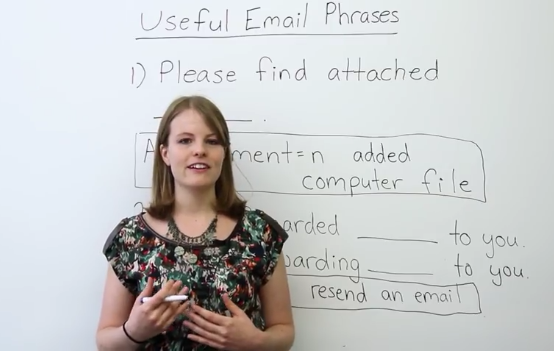
Okay, so our first expression, very common: 'Please find attached _________.' Okay? 'Please find attached _________.'
我们来看第一个表达,这个表达非常普遍:‘请查收附上的______。’
So, what do I mean by 'attached'? So, in this case, 'attached' is a verb,
那么,‘attached’是什么意思呢?在这种情况下,‘attached’是一个动词,
but 'an attachment' which is the same thing but in the noun form, is an added computer file.
但是‘an attachment’里的‘attachment’意思相同却是名词形式,指的是附加的电脑文件。
So it's a computer file we add to an email. So, what are some examples of attachments?
也就是我们附在邮件中的一份文件。那么与附件有关例子有哪些呢?
Well: 'Please find attached my resume.' This may be an added computer file. 'Please find attached photos from the conference.'
例如:‘请查收我附上的简历。’这可能也是一份附加的电脑文件。‘请查收附件中的会议照片。’
So it's a very simple phrase. It's very polite. Notice we have 'please. 'Please find attached _________.'
这个表达非常简单,也非常礼貌。注意这个表达中的‘请’。‘请请查收附上的______。’
And then you just fill in the blank with the computer file you're adding to the email. Okay? So that's our first expression.
然后在空白处填上你要附在邮件中的文件的名称,明白了么?这是我们的第一个表达。
Now let's look at our second expression.
现在来看第二个表达。
'I've forwarded _________ to you.' Or alternatively, we can also say: 'I'm forwarding _________ to you.'
‘我已经将_____转发给你了。’或者,我们也可以说:‘我将______转发给你。’
So, first of all, what do I mean by 'forward'? Okay?
那么首先我们要弄明白,‘forward’是什么意思呢?
Well, a forward... 'Forwarding' is a verb, but it can also be a noun, as in 'forward'.
‘Forwarding’是动词,但是也可以是名词,如‘forward’。
So a 'forward' is when you get an email and you decide you want to resend the email to someone else, so you forward it to them.
‘forward’就是当你有一封邮件并决定将邮件再发给其他人,也就是说你将邮件转发给别人。
So, again, it's when you want to resend an email and you send it to a different email address.
再说一遍,当你想将邮件再发送给别人,你是要将邮件发送到不同的邮件地址中。
So that's a forward. So what can I forward? Well, we've used resume already, we can use it again.
这就是转发。那么我能转发什么呢?我们之前已经拿简历举过例子了,我们可以再用一次。
'I've forwarded...' Maybe you're forwarding someone else's resume, so:'Bill's resume to you.', 'I'm forwarding John's email.'
‘我已经转发...’或许你转发的是别人的简历,那么,‘我已经将Bill的简历转发给你了。’,‘我将转发John的邮件。’
Maybe there was a good email he sent, so you want to forward it to someone else to you.
或许是因为John发了一封不错的邮件,所以你想将这封邮件转给别人。
So that covers forwarding. Ok, now let's look at some more expressions.
这些讲的都是转发。好了,现在让我们看看其他表达。
Okay, so expression number three: 'I've cc'd/cc'ed/copied _________'-and then you write the name of the person 'on this email.'
第三个表达:‘我已经抄送________’——然后在空白处写上别人的名字。
So, what does this mean? Well, sometimes maybe you've written an email to someone, but you want someone else to see what you've written.
那么这个表达是什么意思呢?有时你可能给别人写了一封邮件,但是你想其他人也看到你的邮件。
So the email isn't directed to this person, you just want them to know what's going on, so you might cc them or copy them. Okay?
也就是说,这封邮件并不是直接给这个人,你只是希望他知道这件事,所以你会抄送给他们,明白了么?
So there are three different ways to write this.
关于抄送有三种不同表达。
Remember, in business writing and in formal writing for emails, we really want emails to be short and to the point.
记住在商务邮件和正式邮件中,都希望邮件简单明了。
We want them to be concise, so that's why you may see 'cc'd', not as a word but just with an apostrophe 'd', meaning the past participle.
我们希望邮件简洁,因此,你才会看到‘cc'd’,而不是一个单词,是一撇‘d’,代表过去分词的意思。
'Cc'ed' or 'copied'. All of these are correct to use.
‘Cc'ed’或是‘copied’,这些都是正确的使用方式。
So I could say: 'I've cc'd Umar on this email.' Meaning the email goes to someone, but Umar can also see the email too.
所以我可以说:‘我已经将这封邮件抄送给了Umar。’意思是这封邮件是发送给别人的,但是Umar也可以看到这封邮件。
So the email isn't directed to Umar, he can just see it too.
虽然这封邮件不是针对Umar的,但是他也可以看到。
So why might we cc someone? Well, to keep a person, so someone, in the loop. So this is another common expression you may hear.
那么我们为什么要抄送给别人呢?是为了让别人知道这个消息。这又是另一种你可能听到的常用表达。
When you keep someone in the loop, it means you want them to know what is going on, so you keep them in the loop.
当你让别人知道了这个消息,就意味着你想让他们知道发生了什么事。
Meaning now they know what is happening. Okay?
意味着现在他们已经知道怎么回事了,明白了么?
Expression number four: 'If you have any questions, please don't hesitate to contact me.'
第四个表达:‘如果你有任何问题,请不要犹豫,联系我。’
So, first of all, what does 'hesitate' mean? This might be a word you don't know. It means to wait.
首先,‘hesitate’是什么意思呢?这个单词可能你不知道,这是等待的意思。
So, this can also sound like: 'If you have any questions, please don't wait to contact me.'
也可以说:‘如果你有任何疑问,请立即联系我。’
'Hesitate' is, of course, more formal and it's the one that is commonly used. So this is a great way to actually end an email.
当然‘hesitate’更加正式一些,也是常用词。所以这是一种作为邮件结语的好的表达。
Towards the end, before you say: 'Sincerely' or 'Kind regards, Vanessa' or'Emma' or'Umar' or 'John',
邮件快结尾时,在你说:‘Sincerely’或是‘Kind regards, Vanessa’或‘Emma’或‘Umar’或‘John’之前,
this is a good thing to write before the very end of the email.
在邮件的最末写上这个表达是非常好的。
So here's the fifth expression: 'I look forward to...' and then we have different options.
第五个表达:‘我期待...’可以有期待的事情。
So before I get to those options, 'I look forward to', what does that mean exactly?
在说出这些事情前,我们来看看‘我期待...’是什么意思呢?
Well, it means this is what you want the other person to do and you're saying it in a polite way.
这表示,你想让别人做什么并以一种礼貌的方式说出来。
So:'I look forward to hearing from you.' You want the other person to contact you. 'I look forward to hearing from you.'
比如:‘我期待你的来信。’ 你想让对方再联系你,所以你说‘我期待你的来信。’
And notice we use verb in the 'ing' form. Another thing we could say: 'I look forward to meeting you.' Okay?
注意我们在这里使用的是‘ing’形式。还有一件事我们可以说:‘我期待与你相见。’明白了么?
So this is the action that's going to happen next, and I'm excited about it, I'm looking forward to it.
这是接下来将发生的事情,并且我对此感到兴奋,我非常期待。
I could also, instead of using a verb 'ing', there are so many different variations of this,
我也可以说,替换掉动词ing的形式,还有其他不同表达,
I could say:'I look forward to your reply.' Meaning I'm waiting for your reply. I'm excited to get your reply, although it's not that strong. Okay?
我可以说:‘我期待你的回复。’表示我等待着你的回复。我非常高兴收到你的回复,虽然这种表达不是很强烈,好么?
So this, again, usually comes towards the end of the email and it's just telling the person what action you're waiting for.
强调一下,这个表达通常出现在邮件结尾处,是在告诉对方你对接下来的期待。
Okay, and now how do we sign off on the email after that? Well there are many ways to sign off on an email.
好了,现在,在写完这句话之后,将怎么结束邮件呢?有多种方式结束邮件。
A common way is: 'Kind Regards,' or just: 'Regards,'. So I could say: 'Kind Regards,' and then underneath that, write: 'Emma',
通常的方式是:‘Kind Regards,’,或是‘Regards,’。因此我们可以说:‘Kind Regards,’,之后在底下署名:‘Emma’,
'Regards,' underneath: 'Emma.', 'Warm Wishes,', 'Yours Truly,'.
‘Regards’,之后在底下署名:‘Emma’,或是‘Warm Wishes,’,‘Yours Truly,’。
Again, these are just some suggestions. There are many different ways you can end an email and write your name underneath. Okay?
以上仅是一些建议。还有许多不同表达可用于你的邮件中,并在底下署名,好么?
So, I look forward to reading your comments and hearing about your opinions.
那么,我期待看到大家的意见和观点。
And so, until next time... well, before until next time actually, you can also practice these expressions on our website: www.engvid.com.
下一次,确切的说是在下一次之前,你也可以在我们的网站上:www.engvid.com做些相关练习。
We have a quiz there where you can practice this vocabulary and make sure that you understand it to the fullest. So, until next time, take care.
网站上有一些小测试,可以练习你的词汇量,检测自己是否完全弄懂了。那么下期见。


