(单词翻译:单击)
Hi, there. Welcome to EngVid. Today, we are looking at how to maximize your points on IELTS speaking tests, in particular one and three.
大家好,欢迎来到EngVid。今天我们要来看一看能够给你们的雅思口语考试最大限度加分的几种方法,尤其是针对口语考试的第一部分和第三部分。
I'm going to be giving you some very valuable tips for how to make the most and how to do your very best in these tests.
我会分享一些非常有用的窍门,教你们如何在这些考试中做到最好。
So what do you need to do? You need to answer with a little bit more detail.
那么你们需要怎么做呢?你们需要在回答问题的时候,多加入一些细节。
You need to extend your answers a little bit, okay? Answer the question that they ask.
稍微延伸一下你们的答案。具体地回答考官所提的问题。
Okay. It doesn't matter if you prepare something and they don't -- they ask a question that your answer is no good for, drop it.
如果你们事先准备的答案,他们不......如果你们准备的答案不适用于考官所提的问题,那也没有关系,把准备好的答案忘掉。
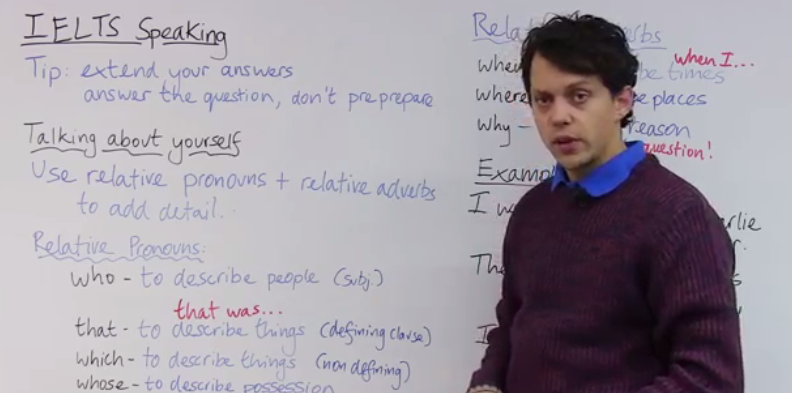
You have to make an effort to answer their question.
你们一定要努力地回答好考官提出的问题。
Now, today, we're gonna be looking at using some relative pronouns and some relative adverbs to lengthen out your sentences a little bit, okay?
今天,我们要用几个关系代词和关系副词来把句子变长一些。
So extending your answers, answering the question.
所以,请用扩展后的答案来回答问题。
As you may be aware, IELTS speaking tests one and three, they're particularly looking for you to give information about yourself, to tell people about yourself, okay?
你们也许注意到了,在雅思口语考试的第一和第三部分,考官们特别希望你们能够介绍一下自己,告诉他们一些你们的情况。
So I'm saying that these pronouns and adverbs are gonna be particularly helpful.
所以这些关系代词和关系副词将会特别有用。
So these pronouns you put in the middle of sentences to continue the sentence and give a bit more information.
这些关系代词是用在句子中间起连接作用的,同时我们也用它们来增加一些信息。
So you'd use "who" to describe people.
在描述人的时候,可以用关系代词" who"。
"The person I met who is a shopkeeper" -- "The person I went to school with who is now a famous movie star" -- okay?
比如" The person I met who is a shopkeeper"(我碰见的那个人是个商店老板)," The person I went to school with who is now a famous movie star" (以前跟我一起上学的那个人,现在成了一位著名影星)。
So "who", when you're giving more information about the person, okay, who's doing something, who's the subject. Okay?
所以,如果你们要讲述关于某个人的一些情况,就用" who",知道了吗?某个人在做什么之类的。这里的" who" 指的就是主语。
You can also use "whom", but it's not so common, "whom" would be the indirect version of this, someone who's not doing something.
你们还可以用" whom",但是" whom"并不是很常用," whom"是" who"的宾格形式,不能在句子中充当主语。
Now, you'd use "that" when you're describing things. Okay?
在描述事物的时候,可以用关系代词" that"。
"I went to Bath on Saturday that was a fantastic place to visit." Okay? So I'm describing the activity of going to a place. Okay?
比如 " I went to Bath on Saturday that was a fantastic place to visit. " (我周六去了巴斯,那是个游玩的好地方),在这里,我描述的是去某个地方这种活动。
Bath itself. Okay? So it's a proper noun.
是巴斯这个地方,这是一个专有名词。
"Which" I can throw in there when I want to also describe things in a non-defining clause sense.
在非限制性从句中描述事物的时候,可以用关系代词" which"。
"The film which I saw on Saturday was really good." Okay? You can get some more information on this on another one of our videos.
比如 "The film which I saw on Saturday was really good."(我星期六看的那部电影非常棒),你们可以在我们网站的另一个视频里找到更多关于" which"的用法。
"Whose" when I'm describing a possession. So, "The car I drove whose owner was Charlie." -- okay?
在描述所有权时,可以使用" whose"。比如 "The car I drove whose owner was Charlie." (我开的那辆车是Charlie的)。
So I'm describing an element of possession. Okay?
在这里我描述的是为某人所有的一个东西。
Now, looking onto the relative adverbs. I can use "when" when I'm talking about times.
下面我们再来看看关系副词。当我们讨论时间的时候,可以使用关系副词" when"。
"I went to school when I was aged 13 to 18." Yeah?
比如 "I went to school when I was aged 13 to 18." (我13到18岁的时候都在上学)。
I can use "where" when I'm talking about the place that something happens.
在讨论某件事发生的地点时,可以用关系副词" where"。
So "I went to the actor's temple, where I learnt a lot about acting." Okay? So giving more information about that particular place.
比如 "I went to the actor's temple, where I learnt a lot about acting."(我去了电影学院,在那儿学到了很多关于表演的知识)。我们用" where"来描述关于这个特定地点的更多信息。
And I can use "why" ,I mean, "why" normally results in a question.
还有关系副词" why",它一般用来引导疑问句。
It's difficult to include "why" and then end in a full stop.
我们很少把" why" 用在肯定句中。
um...So you could say, "I decided to cross the road today. Why do you think that is? Well, I went to go and buy some food."
举个例子来说,"I decided to cross the road today. Why do you think that is? Well, I went to go and buy some food." (我今天去了马路对面。你觉得我为什么这么做呢?我去买了一些食物)。
Now, I'm gonna put some examples here and to show you, you know, how we can use these.
我会在这儿放几个例句来告诉你们应该怎么使用这些词。
"I went to school with Charlie who" -- okay, so now the next bit gives more information about the person, okay?
"I went to school with Charlie who"-- (我跟Charlie一起去的学校,他......)那么,剩下的句子就会对这个人做一些描述。
-- "the man who helped me pass my driving test who" -- so I'm giving even more information about this person, what, he lives in a place in the north of England.
-- "the man who helped me pass my driving test who"(这个帮我通过驾照考试的人,他......)那么接下来我会继续给出关于这个人的一些信息, 比如,他住在英格兰北部的一个地方。
"I enjoyed playing" -- "I played football at school, which was fun." So "which" there is talking about, you know, the activity as I mentioned here.
"I enjoyed playing" -- "I played football at school, which was fun."(我喜欢玩......我在学校的时候踢过足球,非常有趣),那么这里的" which" 就是用来描述我提到过的这项活动的。
And "The teacher whose expertise" -- so I'm talking about the skill that that teacher had. Possessive, okay? -- "the teacher whose expertise helped me pass my exam."
还有"The teacher whose expertise"(这位老师的专长......)我在这里讨论的就是这位老师拥有的技能。所有权,还记得吗?-- "the teacher whose expertise helped me pass my exam." (这位老师的技能帮助我通过了考试)。
Now, I hope I've shed a little light. I know some of these might be unfamiliar to you.
希望以上这些能让你们对关系从句有了一点了解。我知道这其中有些用法你们可能不太熟悉。
Should we just have a quick recap of this?
那我们再来简要地概括一下。
So I'm gonna use "who" when I'm describing people. "The person I went to school with, who is now doing well."
在描述人的时候,可以使用" who"。比如 "The person I went to school with, who is now doing well." (曾经跟我一起上学的那个人现在过得很好)。
"The person I met at the shop, who was a very nice person." Okay?
"The person I met at the shop, who was a very nice person." (我在商店遇到的那个人,是个很和善的人)
So these are kind of small little chunks that you kind of put on to the end of the sentence. Yeah?
这些就是一般可以增加在句尾的小语块。
"The place that I went today was really great." So "that I went today" is the extra bit of information.
"The place that I went today was really great." (我今天去的那个地方非常棒),所以, "that I went today"就是我额外添加的信息。
"Which" -- "The sandwich, which I had at lunch, was really good." So "had at lunch" is that little bit more information.
接下来是" which","The sandwich, which I had at lunch, was really good." (我中午吃的那个三明治很好吃),那么, "had at lunch" 就是增加的一点信息。
"The car, whose owner I really like, was very good to drive." So if you've got a sentence, you're putting in a little bit more information here, and then finishing it here, okay?
"The car, whose owner I really like, was very good to drive." (我很喜欢的那个人的车,非常好开)。所以,在一个句子里面,你们可以在这里添加一些信息,然后在这个部分把它结束。
"The car, whose owner I really like, drives fast." Okay? So you'd separate it with two commas.
"The car, whose owner I really like, drives fast."(我很喜欢的那个人的车,开起来很快)。在这个句子里,要用两个逗号把各个部分分开。
Now, don't worry if you're a little bit confused by this because you can now refer to a very clear quiz that I've created on engvid.com that should test you with these key words and make sure that you've really cemented it, made certain of these words for yourself.
如果你们被这些句子弄得有点糊涂了,也别担心,因为我在engvid.com这个网站上上传了一个非常简单易懂的小测验,你们可以把它作为参考,这个小测验能够测试你们这些关键词,以及确认你们有没有真的记牢、弄懂这些知识点。
So please now go to the engvid.com website and check out the quiz if you're not already there.
如果你们不是在engvid.com上看的这个视频,那就快去engvid网站上看看那个小测验吧。
And hopefully, my answers will make all this a little bit more clear for you.
希望我的答案能让你们对这些知识点更清楚一些。
Do feel free to subscribe to my YouTube channel, and I'd love you also to check out my Exquisite English page.
你们可以订阅我的YouTube频道,也可以去我的英文主页上看看。
Thank you for watching today, and I just hope that using these key little words will help you get that extra bit more information. Well done. Goodbye.
谢谢你们的观看,我希望通过使用这些重要的小单词能够帮助你们弄懂那些额外的信息。辛苦啦,再见。


